
Silence in stone has a story here. This 2-hour Jewish Quarter walk in Seville feels quiet, intimate, and strangely moving, with a guide named Pedro and a focus on the city’s lived history.
I especially loved the Sephardic stories before 1492—merchants, poets, philosophers, and families—told in a way that makes the past feel specific, not vague. I also liked the way the tour reads the neighborhood like a puzzle, pointing out small architectural clues and hidden courtyards.
One consideration: this is a walking tour with no monument entrance stops, so if you’re hoping for big-ticket interiors, you’ll want to plan those separately.
In This Review
- Key things to look for
- Jewish Quarter walking tour: why it feels different in Seville
- Meeting on the right side of the city: where to start
- Pedro’s approach: history that stays human
- How the guide connects Judaism, Islam, and Christianity
- Hidden alleyways and courtyards: what you’re really looking for
- Santa Cruz and the broader Seville context
- Small group size: the difference you feel in real time
- Language notes: Spanish guide, practical expectations
- Price and value: what $34 buys you in Seville
- Who this tour is best for
- Things to bring (and what to skip)
- Practical timing: how the walk fits into your day
- Should you book this Jewish Quarter experience?
- FAQ
- How long is the tour?
- Where does the tour start and end?
- What language is the tour guide?
- Is the tour wheelchair accessible?
- Are monument entrance fees included?
- Is it suitable for kids?
Key things to look for
- Pedro’s Sephardic storytelling keeps the tour focused on real people and real tensions
- Hidden courtyards and narrow lanes help you see the neighborhood’s layers up close
- A three-civilization lens (Judaism, Islam, Christianity) explains how Seville changed over time
- Small group of up to 8 means more back-and-forth and a calmer pace
- No commercial stops keeps your time on the actual streets that matter
- Practical local tips for nearby restaurants and sights come at the right moment
Deeper into the lanes of Santa Cruz
- Seville: Small-Group Jewish Quarter Discovery Walking Tour★ 4.9 · 499 reviews
- VIP Guided Seville Alcazar Pre-Opening, Cathedral & Old Town★ 5.0 · 191 reviews
- Santa Cruz Jewish Quarter Guided Tour in Seville★ 4.0 · 144 reviews
Jewish Quarter walking tour: why it feels different in Seville
Seville has famous sights, sure. But the Jewish Quarter, the streets around Santa Cruz, and the tight turns of the old lanes have their own kind of power—one that doesn’t show up in a postcard.
What makes this experience work is the balance between beauty and meaning. You’re not just looking at pretty white walls. You’re learning how people lived, negotiated, and sometimes feared in a city where Judaism, Islam, and Christianity overlapped in complicated ways. The result is a walk that feels respectful, selective, and thoughtful.
The tour lasts about 2 hours, with around 1.5 hours of guided walking. It’s priced at $34 per person, which is reasonable when you consider the small group size and the fact that it’s built around storytelling rather than a string of paid entrances.
Meeting on the right side of the city: where to start
You’ll meet in the Plaza in front of Hotel Casas de la Judería. From there, you start the walk near Calle San José, which is a smart lead-in because it gets you moving through the neighborhood rather than circling it at the start.
This matters because the Jewish Quarter is a place where orientation comes from walking. If you only look at it from a main street, you miss how the district is shaped by narrow passages, courtyards, and quiet corners.
Your route also ends in the old center, finishing near C. García de Vinuesa in Casco Antiguo. That ending point is helpful if you plan to keep exploring on your own right after the tour.
Pedro’s approach: history that stays human
The biggest strength here is the guide’s style. Pedro is personable, communicative, and full of details that make you feel like you’re learning something you can’t simply Google your way into later.
The content centers on the Sephardic community before the expulsion of 1492. Instead of treating history as dates only, the tour connects ideas to everyday roles—merchants doing business, poets using language and memory, philosophers asking questions, and families living their routines while the atmosphere around them shifted.
That matters because a district like this has layers. You’ll notice how the guide talks about the balance between tolerance and tension, which is exactly the kind of nuance that makes the silence in the stones feel earned, not dramatic.
More paths into old Seville



How the guide connects Judaism, Islam, and Christianity
One of the most useful parts of the tour is the way it frames Seville as a three-way conversation between Judaism, Islam, and Christianity. You’re not left with one story line. You get context for why buildings and legends carry traces of more than one era.
As you walk, you’ll learn how visible and invisible marks shaped the neighborhood—architectural details, local legends, and the way memory can linger even after major historical breaks. You also come away with a clearer sense of how different communities influenced one another, and how coexistence can be delicate.
If you like history that explains cause-and-effect, this is a strong fit. If you only want a simple timeline, you might find the story slightly more interpretive than factual-and-fast. But that’s also why it sticks.
Hidden alleyways and courtyards: what you’re really looking for
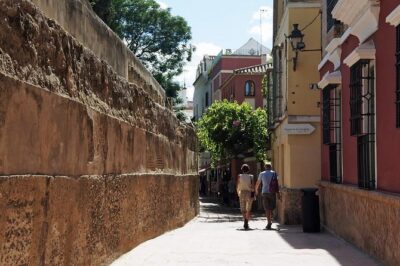
The tour’s pacing is built around small discoveries: narrow lanes, whitewashed surfaces, and courtyards that feel like they’re tucked behind ordinary doors. These aren’t staged “photo stops.” They’re places that help you understand the neighborhood’s design—tight, inward-looking, and shaped for daily life.
A highlight is learning to read architecture as evidence. The guide points out details in houses and street features and then ties those observations back to the cultural history around them. You start noticing patterns instead of just admiring the look.
This is also why the walking format matters. You can’t fully grasp courtyards and alley angles from a distance. You need to be within a few steps, hearing the quiet, seeing how space changes as you turn corners.
Santa Cruz and the broader Seville context
The tour doesn’t isolate the Jewish Quarter like a museum exhibit. It walks you through the Santa Cruz area so you see how the Jewish Quarter connects with the rest of the old city fabric.
In practice, that means you’ll leave with a better mental map of where you are in Seville’s center. Even if you’ve visited once before, it can feel like a new city when you understand the relationships between neighborhoods, eras, and cultural influence.
And because the tour avoids commercial stops, your time stays focused on the streets. That makes it easier to continue exploring afterward without losing momentum.
Small group size: the difference you feel in real time
This is limited to 8 participants. That small group size changes the feel of the tour in a good way.
It helps Pedro tailor explanations on the fly, and it keeps the walk from turning into a line of strangers doing synchronized photo-taking. You can ask questions, and the guide can slow down when a detail matters.
The pace is also part of the value. You get a lot of context, but the tour doesn’t drag. It’s designed to keep you engaged without turning into a lecture that loses the street-level perspective.
Language notes: Spanish guide, practical expectations
The live guide gives the tour in Spanish. Some content is shown in its original language, which can matter if you’re relying on translation alone.
If you speak basic Spanish, you’ll likely follow the flow without too much strain. If you’re not comfortable, you might still enjoy the architecture cues and general story, but you’ll want to accept that parts of the nuance may pass you by.
A useful approach: don’t treat this like a scripted museum audio guide. Treat it like a conversation with a smart local who’s teaching you how to look.
Price and value: what $34 buys you in Seville
At $34 per person for about 2 hours, this is a mid-range walking tour price for Seville. The best value isn’t the length—it’s what you get per minute.
You’re paying for:
- a local guide focused specifically on Sephardic history and culture
- a small group experience (up to 8)
- an interpretation-heavy route through the Jewish Quarter and Santa Cruz
- recommendations for nearby restaurants and other local sites
Also important: entrance fees to monuments aren’t included. That’s not a downside by itself. It usually means your money goes into the guide experience, not into queue time and ticket lines.
If you prefer buying a few paid entries later (at your pace), this format fits well.
Who this tour is best for
This tour is a great match if you:
- like walking tours that teach you to notice details
- enjoy cultural history that connects people, not just buildings
- want a smaller-group experience without commercial detours
It’s also ideal if you’ve been to Seville before and want to see the same area differently. The Jewish Quarter can look familiar on a map, but this type of guided reading makes it feel new.
Not a great fit if:
- you need big monument interiors included
- you’re bringing young kids (it’s not suitable for children under 10)
- you’re looking for a party-style group outing (bachelor and bachelorette groups aren’t allowed)
Things to bring (and what to skip)
Bring a camera. That’s all that’s specifically requested, and it’s a smart choice because the tour focuses on subtle visual details—courtyards, street angles, and architectural clues.
What you should not bring:
- food and drinks
- alcohol and drugs
- anything that breaks standard tour rules like nudity
- bachelor and bachelorette party groups
If you tend to snack while you walk, you’ll want to adjust your plan. You’ll have a better time if you save eating for after.
Practical timing: how the walk fits into your day
A 2-hour slot works well in the morning or late afternoon when the old streets feel calmer. Since it’s mostly walking, you’ll get more out of it if you’re not already exhausted from a full day of long museum stops.
Because the tour ends in the historic center, it’s easy to keep going. You can follow up with local food recommendations from your guide, or pick one nearby sight you’re curious about.
Should you book this Jewish Quarter experience?
Book it if you want Seville to feel personal and specific. This walk does a rare thing: it treats the neighborhood’s silence as meaningful, not empty. With Pedro’s Sephardic focus, you’ll come away with stories that connect the streets to centuries of cultural coexistence and change.
Skip it if you’re looking for a standard highlight tour built around major monuments and paid interiors. This one is built for careful attention—hidden alleyways, courtyards, and the meaning behind stone.
In short: if you care about how a city got to where it is now, and you enjoy walking with a guide who can explain the why, this is a strong pick.
FAQ
How long is the tour?
The experience lasts about 2 hours, with around 1.5 hours of guided walking.
Where does the tour start and end?
You meet at the Plaza in front of Hotel Casas de la Judería. The walk starts near Calle San José and finishes at C. García de Vinuesa in Casco Antiguo.
What language is the tour guide?
The live tour guide provides the tour in Spanish.
Is the tour wheelchair accessible?
Yes, the tour is listed as wheelchair accessible.
Are monument entrance fees included?
No. Entrance fees to monuments are not included.
Is it suitable for kids?
It’s not suitable for children under 10.
Seville History, Done Right
- Sevilla Food Tour: Tapas, Wine, History & Traditions
★ 5.0 · 3,468 reviews - Ultimate Seville Tapas, Wine & History Small Group Tour
★ 5.0 · 1,766 reviews - Seville: Tapas, Taverns, and History Walking Tour
★ 4.9 · 676 reviews - Seville Evening Historical Tour with Haunted History
★ 5.0 · 626 reviews - Historic Gibraltar Rock and St Michael’s Cave Tour from Seville
★ 4.5 · 590 reviews
More Tour Reviews in Seville
- Seville: Live Flamenco Dancing Show Ticket at the Theater
★ 4.7 · 16,396 reviews - Seville: Alcázar, Cathedral & Giralda Skip-the-Line Tour
★ 4.8 · 11,525 reviews - Seville: 1-Hour Guadalquivir River Sightseeing Eco Cruise
★ 4.2 · 10,281 reviews - Seville: Setas de Sevilla Entry Ticket
★ 4.6 · 8,901 reviews - Seville: Cathedral, Giralda & Alcazar Entry With Guided Tour
★ 4.6 · 8,560 reviews
Further Into Santa Cruz
- Seville: Small-Group Jewish Quarter Discovery Walking Tour
★ 4.9 · 499 reviews - VIP Guided Seville Alcazar Pre-Opening, Cathedral & Old Town
★ 5.0 · 191 reviews - Santa Cruz Jewish Quarter Guided Tour in Seville
★ 4.0 · 144 reviews - Seville: 1-Hour Walking Tour Barrio de Santa Cruz
★ 4.5 · 131 reviews - Private Tour Jewish Quarter, center and Plaza de España
★ 5.0 · 127 reviews
Just added to the Seville list






Barrio Santa Cruz & Jewish Quarter, compared.
 ★ 4.9Small-Group Jewish Quarter Discovery Walking TourFrom $29499 reviews
 ★ 5.0VIP Guided Seville Alcazar Pre-Opening, Cathedral & Old TownFrom $138191 reviews
 ★ 4.0Santa Cruz Jewish Quarter Guided Tour in SevilleFrom $24144 reviews
 ★ 4.51-Hour Walking Tour Barrio de Santa CruzFrom $18131 reviews
 ★ 5.0Private Tour Jewish Quarter, center and Plaza de EspañaFrom $189127 reviews
 ★ 5.0Small Group Jewish Quarter Tour with Tapas & DrinksFrom $59119 reviews
 ★ 5.0Seville Jewish Quarter Small Group Tour with Tapas and DrinksFrom $71110 reviews
 ★ 5.0Seville Former Jewish Quarter Walking Tour: Santa CruzFrom $18105 reviews
Browse the lists this tour appears in