
Review · BARRIO SANTA CRUZ & JEWISH QUARTER
Seville Jewish Quarter and Santa Cruz Walking Tour With A Guide
Seville’s old streets have a second voice. This 2-hour Jewish Quarter and Santa Cruz walking tour gives you clear context as you move through the plazas and lanes tied to Sephardic life, Muslim-Christian overlap, and art connections (especially Murillo). I especially liked the straight, historical way the guide ties each square to what you’re seeing, and I also liked how the walk sets you up for the best city moments like the panoramic look from Plaza del Triunfo. One possible drawback: this is mostly a “see-and-learn” city walk, and entry into major monuments/museums isn’t included.
At a price of $84.69 per person for about two hours, it’s not the cheapest way to stroll—but it can feel fair if you want someone to translate the streets fast. I think it’s best when you have the motivation to learn, not just take photos.
One more note to keep you comfortable: group size is small/private, but the walking format means you’ll want good shoes and a bit of patience around tight meeting points in the Casco Antiguo.
In This Review
- Key things I found most useful
- Walking the Santa Cruz story in two hours
- Price and what you’re really paying for
- The guide factor: what to expect (and what to watch)
- Plaza de Santa Cruz: the three-faith map you can walk
- Plaza de los Refinadores: Sephardic boundaries and gates
- Iglesia de Santa Maria la Blanca: where the building holds memory
- Plaza de España (and Plaza Alfaro): pretty streets with a purpose
- Calle Susona: the human story inside the lane
- Plaza de Dona Elvira / Plaza de Santa Cruz area: slow down and look around
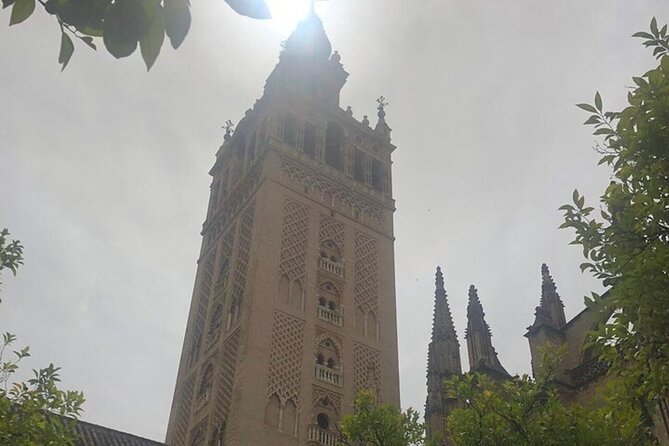
- Plaza del Triunfo: the skyline payoff with the Giralda in view
- Puerta de Jerez: the city changes, and you can trace it
- Universidad de Sevilla in the Royal Tobacco Factory
- Parque de María Luisa: end with green and a big exhibition idea
- What’s included—and what you’ll likely plan separately
- Who should book this tour
- Should you book this Seville Jewish Quarter and Santa Cruz tour?
- FAQ
- How long is the tour?
- How much does the tour cost?
- Is this a private tour or a small group tour?
- What languages are the guides offered in?
- What’s the meeting point?
- Where does the tour end?
- Is monument or museum entry included?
- Are drinks or food included?
- Do I need to worry about transportation during the tour?
- Is the ticket mobile?
- Is free cancellation available?
Key things I found most useful
- Stop-by-stop context in Santa Cruz so the street names and plazas actually mean something
- Murillo-linked sights, including Iglesia de Santa Maria la Blanca and works you’ll be pointed toward
- Panoramic viewpoint payoff at Plaza del Triunfo with key landmarks in view
- Short visit style (roughly 12 minutes per stop) that fits a tight Seville schedule
- Not a monument tour: you’ll learn from the streets and key buildings, while major entries are usually separate
- Guide quality can vary, so it helps to confirm details before you go
Deeper into the lanes of Santa Cruz
- Seville: Small-Group Jewish Quarter Discovery Walking Tour★ 4.9 · 499 reviews
- VIP Guided Seville Alcazar Pre-Opening, Cathedral & Old Town★ 5.0 · 191 reviews
- Santa Cruz Jewish Quarter Guided Tour in Seville★ 4.0 · 144 reviews
Walking the Santa Cruz story in two hours
This is a guided walk designed to cover a lot of ground without turning into an all-day marathon. Expect around ten stops, each paced for about 12 minutes—enough time to orient yourself, understand the meaning of what you’re seeing, and still keep the tour moving through Seville’s compact center.
The area you’ll cover is the kind that can feel confusing if you’re on your own. Santa Cruz has that “I’ve seen this alley before” effect, even though every corner has a different layer of meaning. With a guide, you start noticing patterns: where communities marked boundaries, how faiths overlapped in the built environment, and why certain squares became social magnets.
This kind of tour is also a good way to get your bearings. Seville is easy to wander, but you can waste time wandering with no thread. Here, the thread is the people—especially the Jewish and Sephardic presence—and how their legacy shaped place names and buildings.
Price and what you’re really paying for
$84.69 per person for roughly two hours may sound like a lot until you break down what you get: an in-person guide, a structured route, and practical help if you want to book tickets for other visits. The tour also includes a mobile ticket, which simplifies check-in.
What you’re not paying for is “time inside” monuments. The tour is clear that it’s a city walking experience, not a museum marathon. So the value depends on your goal:
- If you want quick orientation and historical context you can use for the rest of your trip, this is a strong fit.
- If your goal is mainly to enter buildings and spend time inside collections, you’ll need additional ticketed stops on your own.
The guide factor: what to expect (and what to watch)
In the feedback provided, one guide name comes up clearly: Pedro. In that case, the tour is described as professional and full of context—especially about the Jewish Quarter and local customs—adding real value beyond just dates.
But there’s also a cautionary note from a separate experience: a report mentioned a guide arriving late (and the group waiting for a long stretch), poor communication, and no refund after the situation went sideways. That same report also alleges the operator asked for credit card information outside the Viator app.
So here’s my practical takeaway: you can absolutely choose this tour for the content, but if you’re on a tight schedule, build in a buffer. Confirm the meeting details close to departure and don’t wait until the last minute to check where you need to be.
Seville on foot, a few more walks

Plaza de Santa Cruz: the three-faith map you can walk
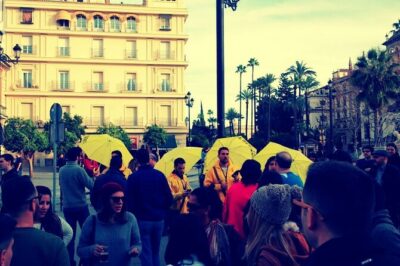
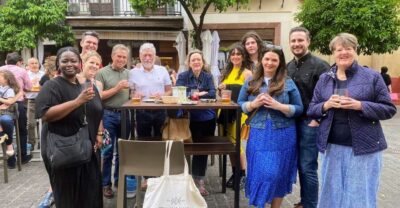
The tour begins at Plaza de Santa Cruz, a square that works like an outdoor timeline. Your guide connects the idea of coexistence—Jewish, Muslim, and Christian presence—to physical landmarks tied to those communities: the kind of places associated with a mosque, a synagogue, and a church.
Even if you only take in the buildings and atmosphere from the street, this stop helps your brain switch from sightseeing mode to “place-reading” mode. You start noticing that Seville isn’t one story—it’s overlapping eras layered into the same blocks.
There’s also an art thread here. You’ll be pointed toward the legacy of Murillo, and the walk encourages you to see how art and memory linger in everyday places like cobbled streets and narrow alleys.
Plaza de los Refinadores: Sephardic boundaries and gates
Next you move toward Plaza de los Refinadores, described as a quieter corner with a strong Sephardic connection. This stop focuses on what used to mark community boundaries—walls and gates that separated or defined the Sephardic quarter.
That’s important because it changes how you look at “old walls” and “city edges.” Without context, you might treat those as just old architecture. With context, they become a practical way to understand how people lived, restricted movement, and built community identity.
You’ll also get another storyline layered in here: a statue of Don Juan, tied to Spain’s Golden Age. This is a good example of why the tour feels more like a guided story walk than a history lecture. It keeps shifting from community life to cultural symbolism, so you never feel stuck in one mood.
Iglesia de Santa Maria la Blanca: where the building holds memory
At Iglesia de Santa Maria la Blanca, you’ll encounter one of Seville’s most meaningful transformations: a former synagogue that later became a Christian church. The point of this stop isn’t just to admire a facade—it’s to look at how the same sacred space can be repurposed while still carrying traces of earlier meaning.
The tour also highlights Murillo again, pointing you toward works associated with the church’s interior. Even with the walking-tour format, this stop is where the story gets heavier and more personal, because it’s about identity, faith, and change through time.
One helpful mindset: try not to treat it like a quick photo stop. Let the guide’s explanation settle first, then look again. That second look is when the architecture starts doing its real work.
Plaza de España (and Plaza Alfaro): pretty streets with a purpose
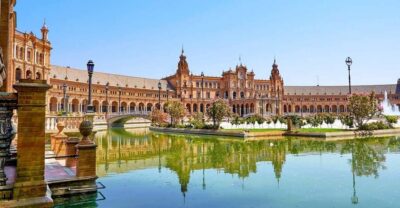
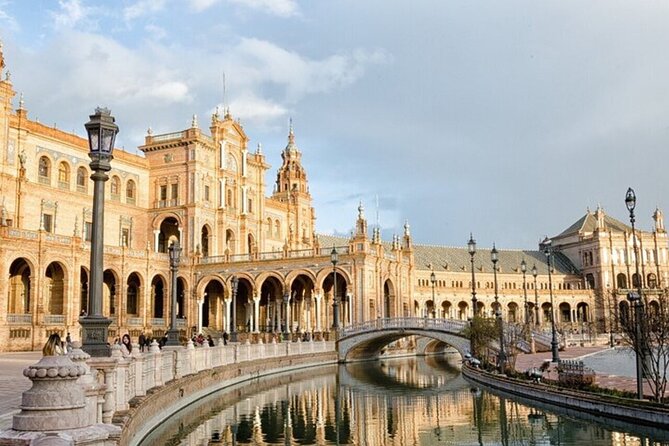
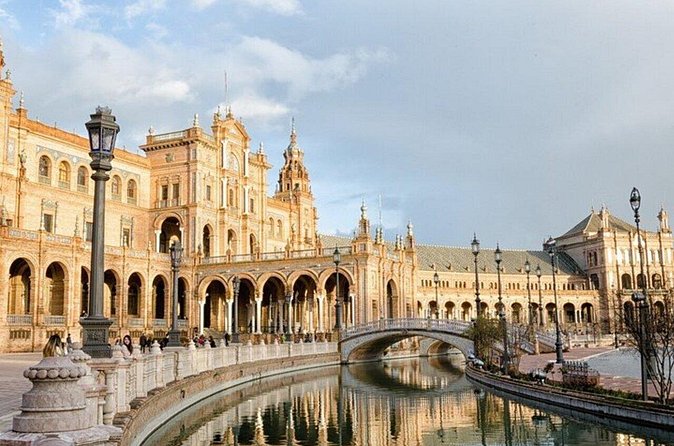
The route then heads to Plaza de España, with the tour description mentioning courtyards and narrow streets linked to Plaza Alfaro. Whether your guide emphasizes one name more than the other, the takeaway is the same: this is a postcard-like place where Seville slows down and gives you space to breathe.
This isn’t just decoration. Moments like this matter because they’re where you reset your attention. After a cluster of smaller lanes and community boundaries, you need a visual open space. You’ll get that here, along with a calmer feel compared to the tighter streets of Santa Cruz.
If you’re the type who likes to read architectural details, this stop is a good chance to do it gently—no rushing, just noticing layout and how people move through the square.
Calle Susona: the human story inside the lane
Then comes Calle Susona, where you’re told about Susona, a legendary figure tied to love, loss, and resilience. This is where the tour adds something people sometimes forget to include in history walks: narrative.
Legends can be less “documented fact” and more “cultural memory,” but they still help explain how communities remembered themselves. In a city like Seville, the story lives in the street name, and the guide’s job is to help you feel why the name matters.
If you enjoy storytelling as a learning tool, this is one of the more memorable stops. It breaks the sequence of place-to-place history and turns the alley into a stage.
Plaza de Dona Elvira / Plaza de Santa Cruz area: slow down and look around
The route includes Plaza de Dona Elvira (the stop description ties it to Plaza de Santa Cruz), and this is essentially your calm-down checkpoint. It’s the kind of square where you can stand for a minute and let the atmosphere settle in—Seville without the loudest crowd pressure.
This stop is useful because it prevents tour fatigue. After multiple “look, listen, move” segments, you get a small window where your only job is to observe the surroundings.
It also helps you pace your day. If you plan to keep exploring after the tour, this is a good chance to spot nearby streets you’ll want to return to later—without being on a schedule.
Plaza del Triunfo: the skyline payoff with the Giralda in view
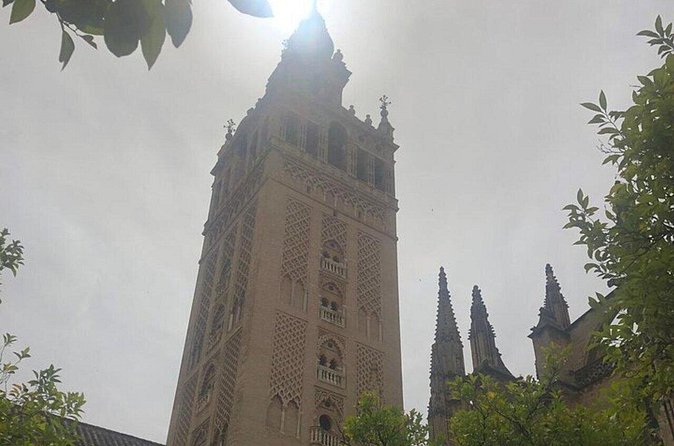
Next is Plaza del Triunfo, where you’ll get panoramic views stretching across Seville. The tour specifically frames what you’ll see: the Giralda and the Alcázar are called out as key landmarks.
This is a smart inclusion. Walk tours can sometimes feel like they’re only about the ground level. But views do two things:
1) they help you map the city in your mind, and
2) they give your eyes a break from walls and doors.
I like that this stop serves as a “reward moment.” After learning about community boundaries and religious conversions, you look out and realize you’re in a city shaped by power, architecture, and long-term symbolism.
Puerta de Jerez: the city changes, and you can trace it
At Puerta de Jerez, the tour shifts into the theme of Seville’s transformation through centuries. You’ll learn about the ancient gateway and how it shaped Seville’s urban landscape—along with stories connected to conquests and the eras that followed.
Even without detailed battle trivia, a gateway stop is useful because it anchors the idea of movement. Gates are where cities meet roads, people meet policies, and boundaries become real.
Practical tip: stand back a moment and look at how the area around a gate funnels movement. That’s how these places worked long before cars and buses.
Universidad de Sevilla in the Royal Tobacco Factory
Then you’ll visit Universidad de Sevilla, housed in the former Royal Tobacco Factory. This stop adds a different kind of history: the story of how a major industrial building became an academic space.
What makes it especially interesting is the literary angle. You’ll connect Seville’s cultural identity to literature—specifically mentioning Mérimée’s inspiration for Carmen.
If you like when a city tour gives you a “why does this matter to me” thread, this is it. Instead of ending with only medieval or early modern themes, you’re reminded that Seville keeps generating culture and stories.
Parque de María Luisa: end with green and a big exhibition idea
Finally, the tour ends at Parque de María Luisa, the green pause in the middle of the city. You’ll hear about the park’s role as the centerpiece of the Ibero-American Exhibition.
This ending matters more than it sounds. If you end in another cramped street, you leave with your brain still in “tour mode.” Ending in a park helps your memories settle. You’ll also have a natural place to decide what to do next—linger for a bit, grab a drink after, or head toward a museum or viewpoint on your own.
What’s included—and what you’ll likely plan separately
Included:
- Walking tour with an in-person guide (English; also Spanish/French/Italian speaking guides)
- Private or small group option, with customization available
- Mobile ticket
- Help from the team to book tickets for visits you want
Not included:
- Tips (optional)
- Drinks and food
- Entry to monuments and museums
- Transportation costs during the tour
Here’s the key implication: don’t assume the stop list means full museum access. You’ll be guided through the city and key buildings, but if you want deeper interior time at major sites, plan that separately.
Who should book this tour
This works well if you:
- Want an efficient way to understand Santa Cruz and the Jewish Quarter context
- Enjoy a guide who links places to people, faith changes, and art connections
- Prefer a structured walk that fits into a busy Seville itinerary
- Are curious about how Seville’s identity shows up in squares, street names, and architecture
You might want a different format if you:
- Only want interiors and tickets inside major monuments (since entry isn’t included)
- Get frustrated by any waiting around a meeting point (there’s at least one reported late-guide issue)
Should you book this Seville Jewish Quarter and Santa Cruz tour?
I’d book it if you’re traveling with curiosity and you like learning from the street level up. The route hits key storytelling locations, and the Murillo connections plus the viewpoint from Plaza del Triunfo help the walk feel like more than a simple stroll.
Just be smart about expectations. This is primarily a guided city walk, not a full-on monument admission package. And because there are a couple of sharp negative experiences tied to communication/timing, double-check meeting details before you leave your hotel. If you do that, you give yourself the best chance to focus on the history and enjoy the day.
FAQ
How long is the tour?
It’s listed as about 2 hours.
How much does the tour cost?
The price is $84.69 per person.
Is this a private tour or a small group tour?
It can be private or small group. It’s described as a private tour/activity where only your group participates, and there is also a group option with a minimum of 2 participants.
What languages are the guides offered in?
The tour is offered in English, and the in-person guide may speak English, Spanish, French, or Italian.
What’s the meeting point?
Meet at C. San José, 37, Casco Antiguo, 41004 Sevilla, Spain.
Where does the tour end?
It ends back at the meeting point.
Is monument or museum entry included?
Entry to monuments and museums is listed as not included. The tour is described as a city tour, not a tour inside the monuments.
Are drinks or food included?
No. Drinks and food are not included.
Do I need to worry about transportation during the tour?
Transportation isn’t included, and any public transport costs are your responsibility.
Is the ticket mobile?
Yes, a mobile ticket is included.
Is free cancellation available?
Yes, free cancellation is available up to 24 hours before the experience start time for a full refund.
More Tour Reviews in Seville
- Seville: Live Flamenco Dancing Show Ticket at the Theater
★ 4.7 · 16,396 reviews - Seville: Alcázar, Cathedral & Giralda Skip-the-Line Tour
★ 4.8 · 11,525 reviews - Seville: 1-Hour Guadalquivir River Sightseeing Eco Cruise
★ 4.2 · 10,281 reviews - Seville: Setas de Sevilla Entry Ticket
★ 4.6 · 8,901 reviews - Seville: Cathedral, Giralda & Alcazar Entry With Guided Tour
★ 4.6 · 8,560 reviews
More Walks Through the Old Town
- Seville: Small-Group City Highlights Walking Tour
★ 5.0 · 1,204 reviews - Cultural Walking Tour of Seville Monumental
★ 5.0 · 861 reviews - Seville: Tapas, Taverns, and History Walking Tour
★ 4.9 · 676 reviews - Seville: Tapas, Taverns and History Guided Walking Tour
★ 4.9 · 515 reviews - Seville: Small-Group Jewish Quarter Discovery Walking Tour
★ 4.9 · 499 reviews
Further Into Santa Cruz
- Seville: Small-Group Jewish Quarter Discovery Walking Tour
★ 4.9 · 499 reviews - VIP Guided Seville Alcazar Pre-Opening, Cathedral & Old Town
★ 5.0 · 191 reviews - Santa Cruz Jewish Quarter Guided Tour in Seville
★ 4.0 · 144 reviews - Seville: 1-Hour Walking Tour Barrio de Santa Cruz
★ 4.5 · 131 reviews - Private Tour Jewish Quarter, center and Plaza de España
★ 5.0 · 127 reviews
Just added to the Seville list



Barrio Santa Cruz & Jewish Quarter, compared.
 ★ 4.9Small-Group Jewish Quarter Discovery Walking TourFrom $29499 reviews
 ★ 5.0VIP Guided Seville Alcazar Pre-Opening, Cathedral & Old TownFrom $138191 reviews
 ★ 4.0Santa Cruz Jewish Quarter Guided Tour in SevilleFrom $24144 reviews
 ★ 4.51-Hour Walking Tour Barrio de Santa CruzFrom $18131 reviews
 ★ 5.0Private Tour Jewish Quarter, center and Plaza de EspañaFrom $189127 reviews
 ★ 5.0Small Group Jewish Quarter Tour with Tapas & DrinksFrom $59119 reviews
 ★ 5.0Seville Jewish Quarter Small Group Tour with Tapas and DrinksFrom $71110 reviews
 ★ 5.0Seville Former Jewish Quarter Walking Tour: Santa CruzFrom $18105 reviews
Browse the lists this tour appears in