
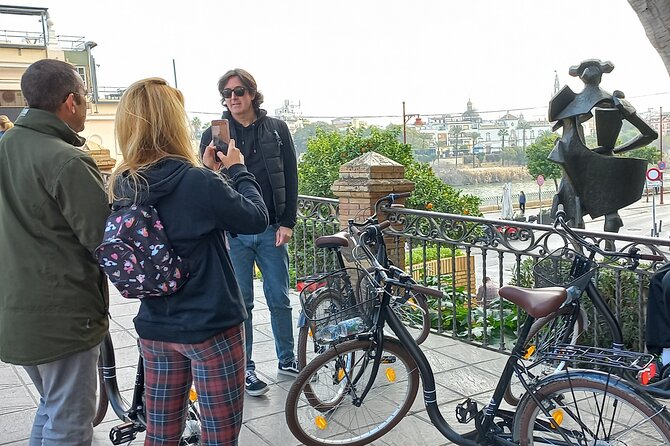
Review · CITY TOURS
Seville In Season- City Highlight Tour
Seville is a city you feel in motion, and this 3-hour bike highlight tour is a fast way to get your bearings. I like that you cover both riverbanks in one go, and each stop is paired with clear context, from Triana’s flamenco roots to the stories behind the Torre del Oro and the Alcázar. One thing to keep in mind: it runs on good weather, and the stops are short, so you’ll be skimming the surface unless you plan follow-up visits.
What also improves the experience is the small group size (up to 12) and the quality of the human factor. Guides like Veronica, Antonio, Pablo, and Marco come up again and again for being friendly, accommodating, and big on practical local tips like photo spots and where to spend your time. You’ll likely enjoy it most if you’re happy riding a bike at a sightseeing pace and you want an efficient first-day overview.
In This Review
- Key things that make this tour worth your time
- What you actually get in 3 hours on a bike
- First Stop: Puente de Isabel II and the Triana Bridge viewpoint
- Triana neighborhood: flamenco roots and Moorish-made goods
- Santa Ana in Mudejar style: the Triana church you’ll remember
- Torre del Oro: the watchtower and the defensive chain story
- Palau de San Telmo and Real Alcázar: power from sea to throne
- Plaza del Cabildo: a calm pause tied to the cathedral world
- Real Fábrica de Tabacos and the Carmen connection
- Parque de María Luisa and Plaza de España: the 1929 turning point
- Price, value, and why $36.20 can make sense
- Who this tour fits best (and who should pick something else)
- Quick practical tips so you enjoy the ride
- Should you book this Seville In Season City Highlight Tour?
- FAQ
- How long is the Seville in season city highlight tour?
- What’s the price per person?
- Is the tour offered in English?
- Do I get a mobile ticket?
- Where does the tour start and end?
- What’s included in the price?
- Are there admission tickets required for the stops?
- How large is the group?
- What if the weather is poor?
- Is hotel transfer included?
Key things that make this tour worth your time
- Small group feel (max 12): easier conversation and less standing around.
- Bike + helmet + water included: you’re set up to ride without last-minute shopping.
- Triana-to-riverfront routing: you get both sides of Seville’s Guadalquivir story.
- Short, focused stops: quick photo windows plus real explanations.
- Major sights in one loop: Real Alcázar and Plaza de España are both on the route.
- Guides with local insight: named hosts like Veronica, Antonio, Pablo, and Marco are consistently praised.
Still deciding? A few more Seville picks worth a look.
- Seville: City Sightseeing Hop-On Hop-Off Bus Tour★ 4.0 · 4,633 reviews
- Seville: Highlights City Bike Tour★ 4.8 · 2,168 reviews
- City Sightseeing Seville Hop-On Hop-Off Bus Tour★ 4.0 · 1,782 reviews
What you actually get in 3 hours on a bike
This is a tight “highlights” format: around 3 hours, with multiple stops that are mostly 10–20 minutes each. The value is that you don’t waste your first day figuring out where everything is; the route is built to show you the city’s main geography—especially the river and the big ceremonial spaces.
You ride with a bicycle, plus a homologated helmet, bottled water, and a helmet/basket setup (useful for keeping small items handy while you stop for photos). There’s also a map and information points along the way, aimed at helping you understand what you’re looking at and where you’ll want to go next.
For timing: it’s not a museum marathon. If you want long interior stays, you’ll use this tour as the “see it once, then choose where to return” plan.
First Stop: Puente de Isabel II and the Triana Bridge viewpoint
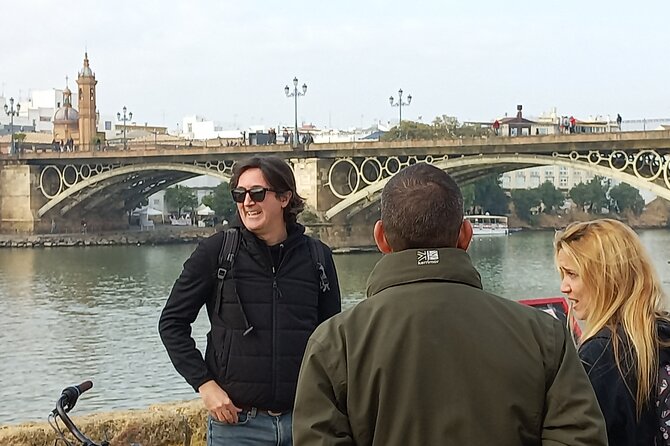
You start at Segway Sevilla Tours, then head straight for the iconic bridge area: Puente de Isabel II, also called the Puente de Triana. Standing near the bridge, you get a view that explains why the Guadalquivir matters. The tour frames this stretch as tied to the Port of the Indies, where Christopher Columbus and other navigators departed or returned with goods from America.
This stop works even if you’re short on time, because the view is the lesson. You can take photos, but you also learn how Seville functioned as a gateway city—ports, trade, and power all running through this waterline.
A practical note: bridges can mean bright sun and wind off the river. Bring sunglasses and expect the light to change fast for photos.
Triana neighborhood: flamenco roots and Moorish-made goods
From the bridge, you move into Triana, one of Seville’s most characterful neighborhoods. The tour connects Triana to three standout identities: it’s described as the cradle of flamenco, tied to important bullfighters, and linked to early Moorish ceramic factories.
What I like about this stop is the way it sets you up for what you’ll notice later when you wander on your own. After hearing Triana described this way, doorways, courtyards, and street rhythms start to make sense. It’s not just pretty streets; it’s a neighborhood with cultural credentials.
This is also a good moment to slow down for a few photos and decide how you want to explore Triana later. If you’re planning a separate evening for flamenco, this stop helps you pick the right neighborhood mood.

Santa Ana in Mudejar style: the Triana church you’ll remember
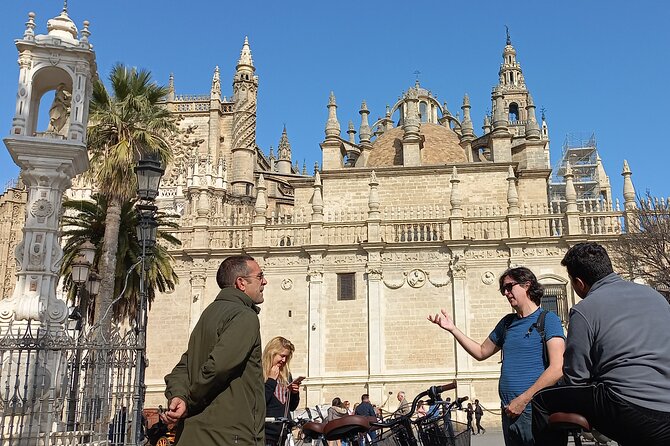
Next comes Iglesia de Santa Ana, often treated as the unofficial Cathedral of Triana by popular sentiment. The tour explains it as the first Catholic church built in Seville after the end of Muslim rule in 1248, and it’s noted for its Mudejar style.
Mudejar style is one of those terms that can sound academic until you see it described. Here, it helps you understand the church as a transition point—Seville changing religious power while keeping artistic continuity.
The drawback? Interior time is brief (around 10 minutes). If you love churches for their details, plan to come back later with more time.
Torre del Oro: the watchtower and the defensive chain story
Then you roll to Torre del Oro, one of Seville’s most recognizable landmarks. The tour frames it as an Arab-built watchtower on the left bank of the Guadalquivir. Even better, it includes a striking defensive detail: it originally connected by a gigantic chain to another tower on the Triana bank.
This is the kind of story that makes the skyline feel alive. When you’re riding, you aren’t just looking at a tower; you’re picturing how ships and defenses worked centuries ago.
There’s also a clever cross-reference in the tour: it nods to nearby landmarks tied to Seville’s identity, including the Real Maestranza bullring, the Maestranza Theater, and a mention connecting to Magellan’s first world voyage. You don’t need to know the whole background to benefit; the guide’s job is to give you a thread you can follow later.
Palau de San Telmo and Real Alcázar: power from sea to throne
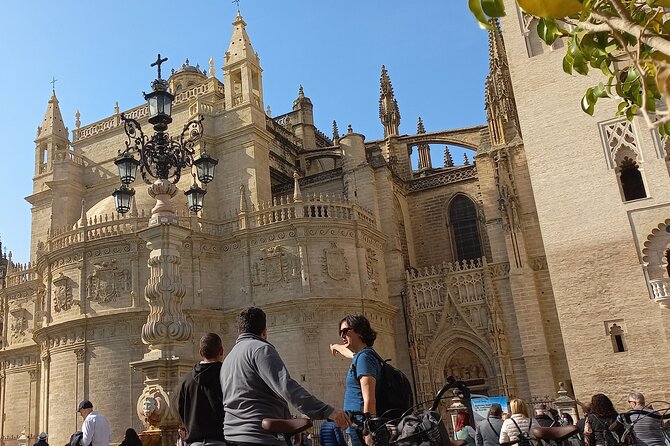
At Palau de San Telmo, you hear the shift from river commerce to maritime training. The building is described as Baroque, and it’s also today the seat of the Presidency of the Junta de Andalucía. But the big story here is older: it was built in 1682 as a marine academy, training pilots, navigators, and high-ranking officers, and it takes its name from San Telmo, the patron saint of seafarers.
You’ll feel the difference between this stop and the previous one. Torre del Oro tells you how Seville protected movement. Palau de San Telmo tells you how Seville learned to manage movement.
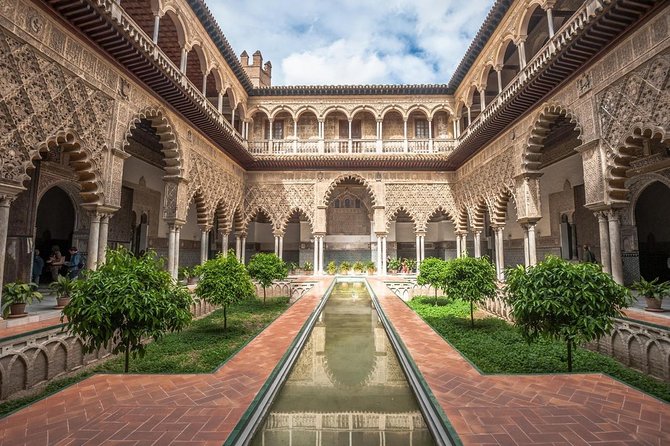
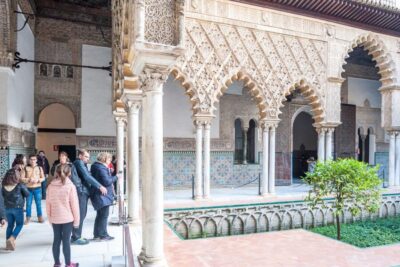
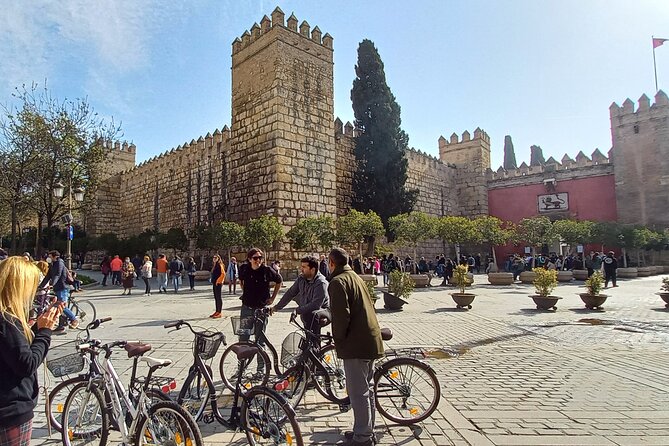
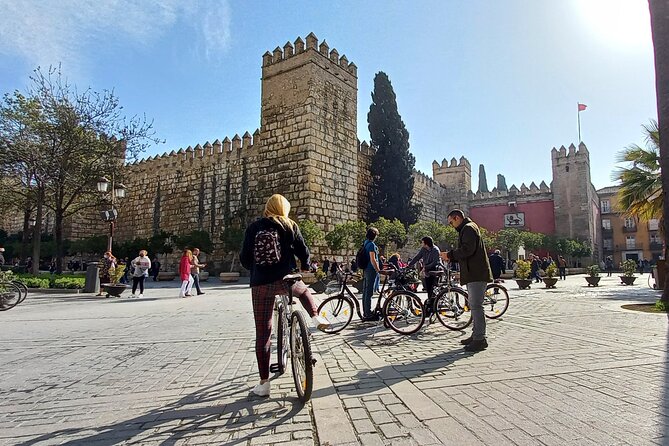
Then comes Real Alcázar de Sevilla, introduced simply as a fortified palace. The tour emphasizes that it’s been a royal residence through multiple eras and is described as the oldest royal palace in Europe. You’ll also hear the modern pop-culture hook: it’s been used for filming, including Game of Thrones.
Again, the time is short (about 15 minutes), so you’re not doing a full palace tour. Instead, you’re getting the right “first impression” so you can decide if you want to go in for the details.
Plaza del Cabildo: a calm pause tied to the cathedral world
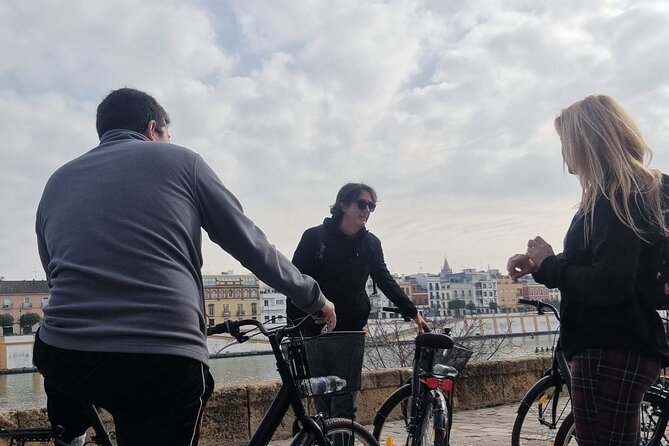
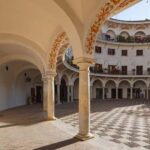
After the palace area energy, you arrive at Plaza del Cabildo, described as a quiet haven. The context is the old College of San Miguel, founded in the 13th century by Alfonso X the Wise, later linked to cathedral life through the master of the chapel and the choir boys.
You’ll notice how the square’s tone fits the name: not a big showpiece where you have to shout over traffic, but a place to stand, look up at the arches and columns, and regroup. The tour also points out practical things you can do with this stop nearby—there are antique and philately shops, plus a candy store connected to convent traditions in the city.
If you like urban “in-between” spaces, this is one of the better moments on the route because it gives you a breather without leaving you bored.
Real Fábrica de Tabacos and the Carmen connection
Next is Real Fábrica de Tabacos, and it’s framed with one standout fact: 75% of all cigars sold on the continent were made in this building. The tour connects the site to culture through Bizet’s Carmen, explaining that Carmen’s factory setting is tied to the tobacco world of Seville, where she works and where the story’s romance ignites.
This stop is smart for two reasons. First, it changes your understanding of Seville’s economy—you see that not all importance came from ports and palaces. Second, it gives you a reference point for how a city can become famous through art, even when it’s rooted in industry.
Time is brief (about 15 minutes), so if you want to go deeper into the building itself, treat this as a “name it so you can return” stop.
Parque de María Luisa and Plaza de España: the 1929 turning point
Then you shift from hard architecture to softer walking time at Parque de María Luisa. The park is described as Seville’s most beautiful park, and it was the venue for the Hispano-American Exposition of 1929. The tour also notes it was once private gardens tied to Palacio de San Telmo.
You’ll make short explanatory stops around areas like Glorieta de Bécquer and Plaza de América, and this is where the bike tour becomes a “ride and reset” rhythm. In the shade and open space, you get less pressure to sprint from sight to sight.
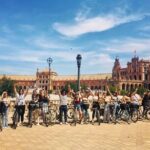
Finally, you arrive at Plaza de España, the big showpiece. The tour describes it as a jewel of the city designed in Regionalist styles by architect Aníbal González, built as a symbol of the Ibero-American Exposition of 1929. The square is also connected to a visible statue of González, so you can orient yourself quickly.
Right after that is Plaza de América, where the tour points out three buildings from the exhibition era (built between 1913 and 1916) with different architectural styles.
This part is where you’ll feel the payoff. You came for the efficiency, and you end with a space that makes Seville look like Seville.
Price, value, and why $36.20 can make sense
At $36.20 per person for roughly 3 hours, the price doesn’t come from museum entry fees. The route is built around major outdoor and accessible stops, and the itinerary lists admission as free for each stop. So what you’re paying for is the structure, the bike, and a guide who ties the sites into one understandable storyline.
For value, that matters. A lot of city tours charge a lot just to move you between places. This one tries to do three jobs: get you from point A to point B, give you explanations for what you’re seeing, and help you avoid spending your limited time guessing what’s important.
Is it perfect value for everyone? Not if you want slow wandering, long church interiors, or a deep-dive palace day. But if you want a smart first-day plan, it’s hard to beat.
Who this tour fits best (and who should pick something else)
This is a great fit if you’re visiting for the first time and you want a guided overview without exhausting your legs on hours of walking. The route focuses on key landmarks you’re likely to return to—Triana, the Alcázar area, and the Plaza de España complex—so you’ll leave with a list of what to explore next.
It also suits people who like active sightseeing. One helpful detail from the overall experience is that the city is described as cycle-friendly, with lots of cycle paths, which makes riding feel practical rather than stressful.
You might choose a different option if:
- You don’t want to ride a bike as part of your sightseeing.
- You’re hoping for long entry times inside the major monuments.
- You’re visiting in conditions that make riding uncomfortable, since the tour requires good weather.
Quick practical tips so you enjoy the ride
A few things that will make the experience smoother:
- Wear comfortable shoes. You’ll stop often, and you’ll be doing short stretches on foot.
- Plan for sun and wind near the river. Sunglasses help, and bottled water is a real upgrade rather than a suggestion.
- Bring your phone for photos, but don’t treat every stop like a photo race. A couple minutes to listen to the story makes the sight click.
Also, you’ll get the most from the tour if you ask your guide a simple question: what should you see next, based on how much time you have. Guides here are described as accommodating and strong on local tips, like knowing where to grab the best views.
Should you book this Seville In Season City Highlight Tour?
Yes, if your goal is orientation plus iconic sights in a short time. The combination of bike comfort, small group size, and strong guide performance makes it a practical first-day choice. It’s also a smart way to connect Seville’s different identities—Triana culture, river power, royal architecture, and the 1929 showpiece squares—without spending your whole day bouncing around alone.
Don’t book it if you want a slow, unhurried, museum-style experience. This tour is fast by design, and it’s meant to point you toward deeper visits you’ll take on your own afterward.
If your schedule is flexible and the weather looks workable, I’d book it early in your trip so you can use what you learn to guide the rest of your days.
FAQ
How long is the Seville in season city highlight tour?
It’s approximately 3 hours.
What’s the price per person?
The price is $36.20 per person.
Is the tour offered in English?
Yes, it’s offered in English.
Do I get a mobile ticket?
Yes, the tour includes a mobile ticket.
Where does the tour start and end?
It starts at Segway Sevilla Tours on C. Álvarez Quintero, 44, Casco Antiguo, and it ends back at the same meeting point.
What’s included in the price?
Included: bicycle use, bottled water, a homologated helmet, liability insurance, basket, map, and information points of interest such as tapas.
Are there admission tickets required for the stops?
The itinerary lists admission as free for each stop.
How large is the group?
The tour has a maximum of 12 travelers.
What if the weather is poor?
The experience requires good weather. If it’s canceled due to poor weather, you’ll be offered a different date or a full refund.
Is hotel transfer included?
No, transfer to your hotel is not included.
More City Tours in Seville
- Seville: City Sightseeing Hop-On Hop-Off Bus Tour
★ 4.0 · 4,633 reviews - Seville: Highlights City Bike Tour
★ 4.8 · 2,168 reviews - City Sightseeing Seville Hop-On Hop-Off Bus Tour
★ 4.0 · 1,782 reviews - Seville: Relaxing City Bike Tour with a Tour Guide
★ 4.8 · 1,588 reviews - Seville: Small-Group City Highlights Walking Tour
★ 5.0 · 1,204 reviews
More Tours in Seville
- Seville: Alcázar, Cathedral & Giralda Skip-the-Line Tour
★ 4.8 · 11,525 reviews - Seville: Cathedral, Giralda & Alcazar Entry With Guided Tour
★ 4.6 · 8,560 reviews - Seville: Priority Access Cathedral, Giralda & Alcázar Tour
★ 4.8 · 7,563 reviews - Seville: Alcázar and Cathedral Entry Ticket and Guided Tour
★ 4.6 · 5,056 reviews - Seville: City Sightseeing Hop-On Hop-Off Bus Tour
★ 4.0 · 4,633 reviews
More Tour Reviews in Seville
- Seville: Live Flamenco Dancing Show Ticket at the Theater
★ 4.7 · 16,396 reviews - Seville: Alcázar, Cathedral & Giralda Skip-the-Line Tour
★ 4.8 · 11,525 reviews - Seville: 1-Hour Guadalquivir River Sightseeing Eco Cruise
★ 4.2 · 10,281 reviews - Seville: Setas de Sevilla Entry Ticket
★ 4.6 · 8,901 reviews - Seville: Cathedral, Giralda & Alcazar Entry With Guided Tour
★ 4.6 · 8,560 reviews
Just added to the Seville list


City Tours, compared.
 ★ 4.0City Sightseeing Hop-On Hop-Off Bus TourFrom $334,633 reviews
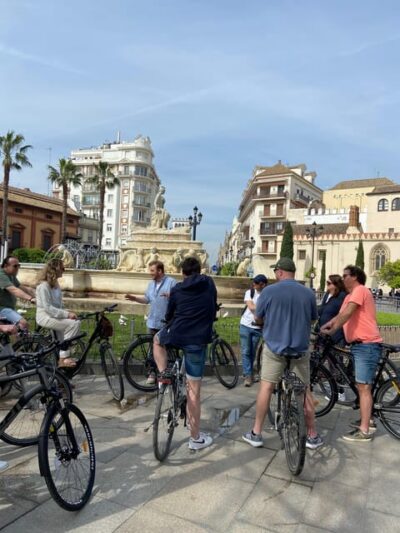 ★ 4.8Highlights City Bike TourFrom $382,168 reviews
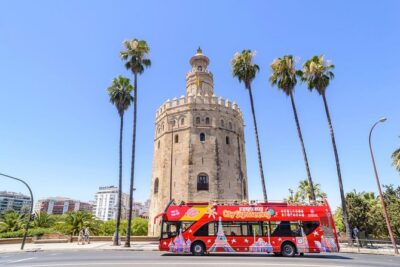 ★ 4.0City Sightseeing Seville Hop-On Hop-Off Bus TourFrom $331,782 reviews
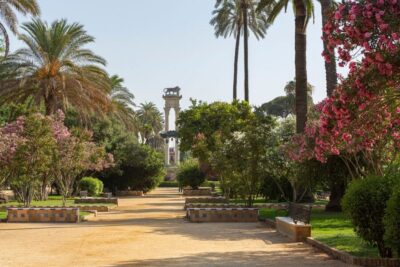 ★ 4.8Relaxing City Bike Tour with a Tour GuideFrom $351,588 reviews
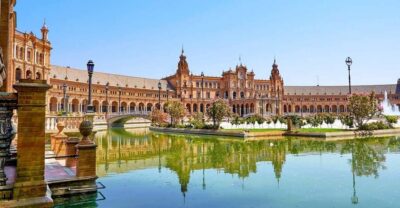 ★ 5.0Small-Group City Highlights Walking TourFrom $271,204 reviews
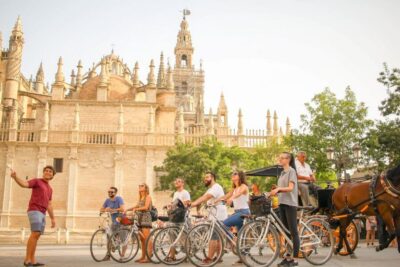 ★ 4.9City Sightseeing and Local Culture Bike TourFrom $311,120 reviews
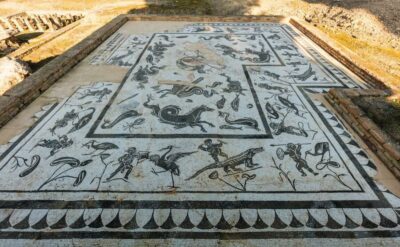 ★ 4.5Italica Roman City & Medieval Monastery TourFrom $461,051 reviews
 ★ 4.8Private City Tour by Eco Tuk TukFrom $33963 reviews
Browse the lists this tour appears in