
Review · SEVILLE OLD TOWN WALKS
Private Half Day Walking Tour of Seville
Seville’s landmarks stack up fast. This private half-day walk ties together Moorish towers, Gothic power, and modern architecture in just 2 to 3 hours. I like the story-led pacing from the start, with guides such as Carlos and Fernando turning big monuments into clear, human-scale scenes.
Two things I especially value: first, the 30-years-experienced official guide who explains what you’re looking at and why it mattered. Second, the route is efficient without feeling rushed in content—Carlos in particular is described as especially attentive to comfort needs like shade and bathrooms, which matters a lot in Seville heat.
One possible drawback: this is still a walking tour with lots of exterior views, so you’ll want moderate stamina and you should expect a brisk pace more than a sit-down museum day.
In This Review
- Key highlights you’ll actually feel on this tour
- From Puerta de Jerez to the Hotel Alfonso XIII: starting with the city’s “front door”
- Jerez Gate Plaza to the Royal Tobacco Factory: where Carmen still echoes
- Palacio de San Telmo and Maria Luisa Park: Discovery-era ambition at street level
- Torre del Oro and the maritime story of Seville
- Postigo Arch and Real Shipyards: gates, shipbuilding, and film-fueled curiosity
- Plaza del Cabildo: a beautiful square with a working-weekend pattern
- Seville Cathedral and the Giralda: reading Gothic power over an Islamic past
- General Archive of the Indies: the “paper” side of Seville’s empire
- Real Alcázar exteriors: kings, mudéjar style, and Dorne
- Santa Cruz walking: the old Jewish Quarter with patios and opera references
- Giralda one more time, plus City Hall: how Seville looks at different angles
- Church of El Salvador: from first mosque to collegiate church and preserved courtyard
- Metropol Parasol mushrooms (Setas) and Calle Sierpes: Seville’s modern twist and a Cervantes link
- Ending at Plaza de San Francisco: the heart of Seville within walking reach
- Price and value: what $133 gets you (and what it doesn’t)
- Who this tour fits best
- Should you book? My straight answer
- FAQ
- How long is the Seville private half-day walking tour?
- Where does the tour start and where do you finish?
- Is this a private tour or a shared group?
- What language is the tour offered in?
- What’s included in the price?
- Is transportation included?
- How physically demanding is the walking?
- Are service animals allowed?
- What happens if the weather is poor?
- Is free cancellation available?
Key highlights you’ll actually feel on this tour
- Guide storytelling that makes big buildings make sense fast
- Exterior-first route that still hits the Cathedral, Alcázar, and key squares
- Comfort-minded guidance noted by guests, especially for shade and breaks
- Game of Thrones connections spotted around shipyards and Dorne at the Alcázar
- Major UNESCO stops like the Archive of the Indies without long transfers
Seville on foot, a few more walks
- Seville: Small-Group City Highlights Walking Tour★ 5.0 · 1,204 reviews
- Cultural Walking Tour of Seville Monumental★ 5.0 · 861 reviews
- Seville: Tapas, Taverns, and History Walking Tour★ 4.9 · 676 reviews
From Puerta de Jerez to the Hotel Alfonso XIII: starting with the city’s “front door”
You begin at Puerta de Jerez, one of Seville’s old gates in the historic center. From here, the tour quickly frames Seville as a layered city: Islamic-era foundations, Christian-era power, and then the 20th-century “world expo” style that still shapes the landscape today.
Just nearby is the Hotel Alfonso XIII, built for the 1929 Ibero-American Exposition. Even if you never go inside, its setting helps you read the city as something that keeps reinventing itself. You also see the buildings around the plaza, including the Palacio de San Telmo and the Tobacco Factory area that leads into the next stops.
This start is a good idea for first-timers because you get orientation early. By the time you reach the heavier hitters later (Cathedral and Alcázar), you’re not just looking—you’re placing each landmark in the bigger story of Seville.
Jerez Gate Plaza to the Royal Tobacco Factory: where Carmen still echoes
A short walk brings you to the Royal Tobacco Factory of Seville, now the Rectorate of the University of Seville. The building is huge—considered the largest in Spain after the Escorial—so it can feel like a fortress even from the outside.
Here’s a key detail to watch for: the site isn’t just “an old factory.” It’s famous as the setting that inspired Bizet’s opera Carmen. When the guide connects that cultural reference to the building’s scale and history, the exterior view turns into a mental stage set.
This stop is also useful practically. Seville’s center can be dizzying, and the Tobacco Factory acts like a visual anchor. If you’ve been walking around on your own before this tour, this gives you a structure for your next hours.
Palacio de San Telmo and Maria Luisa Park: Discovery-era ambition at street level
Next comes the Palacio de San Telmo, seen from the outside. It started life as a school for navigators connected to the Discovery of America, and later it became a residence for the Spanish royal family.
The guide’s job here is to help you notice how the building’s purpose shifts through time. It went from training seafarers to embodying royal prestige, and that shift still shows in how Seville surrounds it.
You’ll also hear about its garden connection: today, the Maria Luisa Park sits in this same spirit of public space and exposition-era beauty. Even without entering, you’ll understand why this area looks designed for visitors, not just locals.
More days with a guide of your own

Torre del Oro and the maritime story of Seville
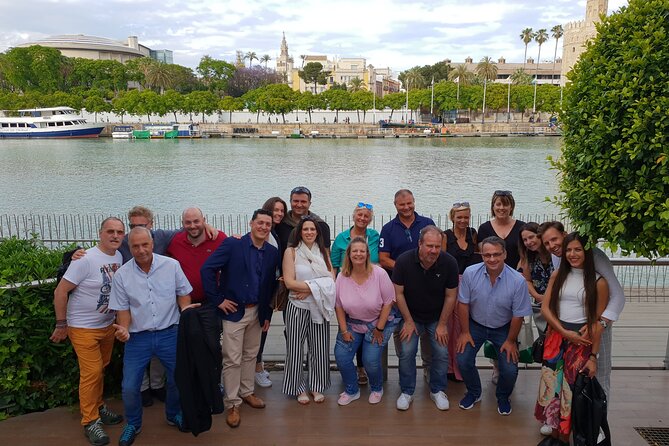
Then you’ll see the Torre del Oro from the outside, an important marker of Seville’s Islamic architecture from the 13th century. The big takeaway is the tower’s job in history: it had real importance in maritime traffic, tied to how Seville handled shipping and trade.
Towers in Seville aren’t just pretty silhouettes. This one is a clue to how the city functioned as a gateway. Once you get that “ports and movement” mindset, later stops like the shipyards and the Archive of the Indies click into place.
If you’re a photo person, this is one of the easiest stops to appreciate without rushing. It helps your eye “lock on” to the city’s navigation past and not only its tourist present.
Postigo Arch and Real Shipyards: gates, shipbuilding, and film-fueled curiosity
You’ll spot the Postigo Arch from the outside, one of Seville’s old gates that’s still preserved. It’s the kind of detail you might miss alone, because it doesn’t shout like the Cathedral. On a guided walk, it becomes a small but meaningful piece of the city’s defenses and layout.
From there, you look at the Royal Shipyards, tied to how ships going to America were built. This is also where the tour leans into pop-culture attention: the area was recently used for Game of Thrones filming.
That matters because it changes how you look at industrial spaces. Instead of thinking shipyards are just “behind-the-scenes,” you learn that they sit inside the historic narrative of global connection. It’s Seville as a working port city, not only a postcard.
Plaza del Cabildo: a beautiful square with a working-weekend pattern
The walk continues to Plaza del Cabildo, one of Seville’s special squares. You’ll hear why it’s linked to the Cathedral world—canons of the Cathedral stayed here—and why it carries a tradition that still feels alive today.
One practical detail: there’s an old antiques market held on Sundays. Even if you’re not visiting on Sunday, the point is that the square has a role beyond sightseeing. It’s a place where daily life and history overlap.
This stop also helps you slow down. Squares give your feet a breather and let your brain file the day’s information. After the heavier landmark exteriors, that pause is not just nice, it’s smart.
Seville Cathedral and the Giralda: reading Gothic power over an Islamic past
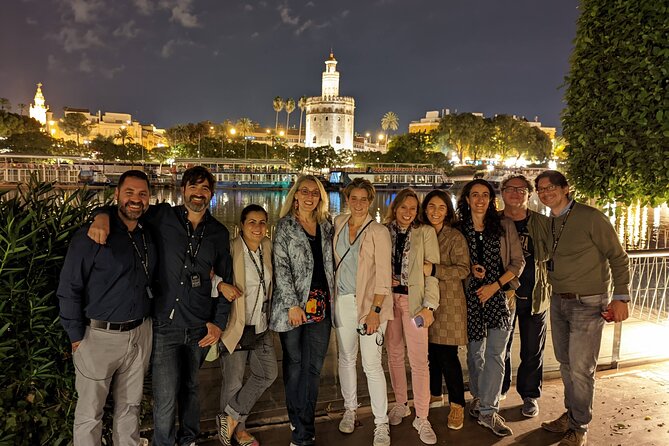
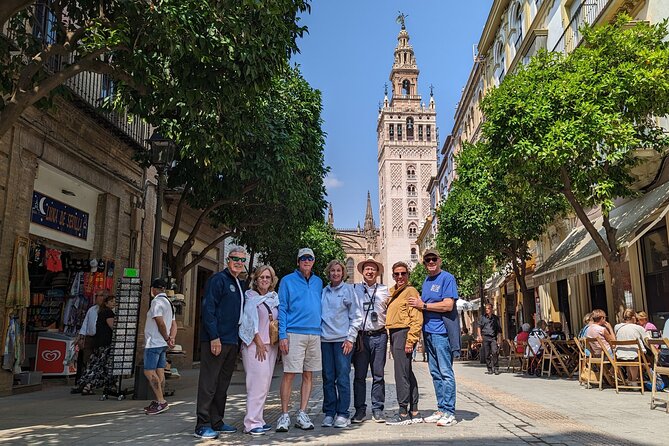
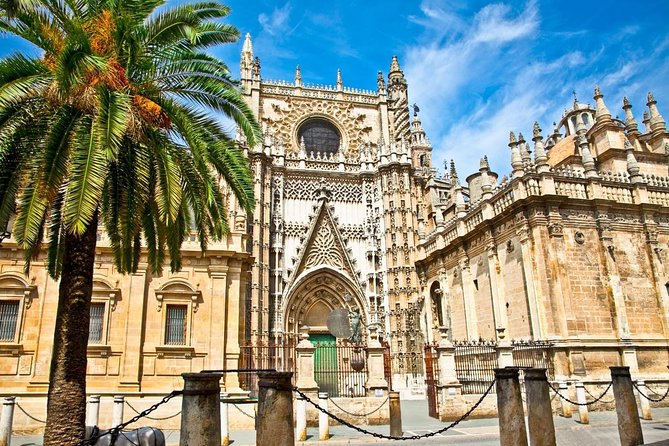
Next up is the exterior of Seville Cathedral, the largest Gothic temple in the world and a UNESCO World Heritage Site (1987). The guide explains the fusion that makes Seville so different: you’re looking at Gothic architecture layered on top of the site’s earlier life as the main mosque of Seville.
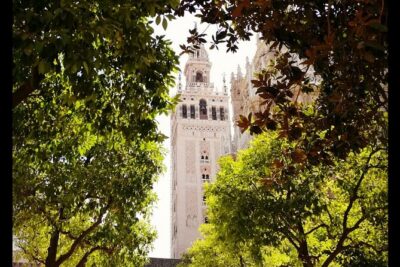
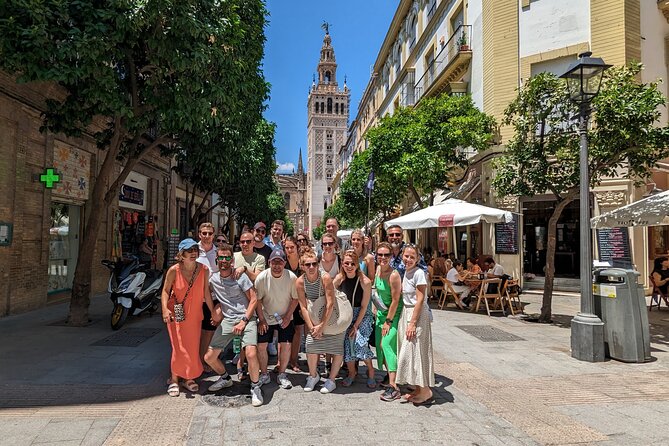
The Cathedral’s bell tower, the Giralda, is the city symbol. You’ll see it from the outside as part of this walk, and you’ll also have another look later, which helps you understand how the tower shifts with viewpoints.
Here’s how to make this stop more satisfying: don’t just stare at the top. Watch the transitions—how the base sits in the street scene, how the tower reads against surrounding buildings, and how Seville’s Islamic and Christian chapters both show up in stone.
General Archive of the Indies: the “paper” side of Seville’s empire
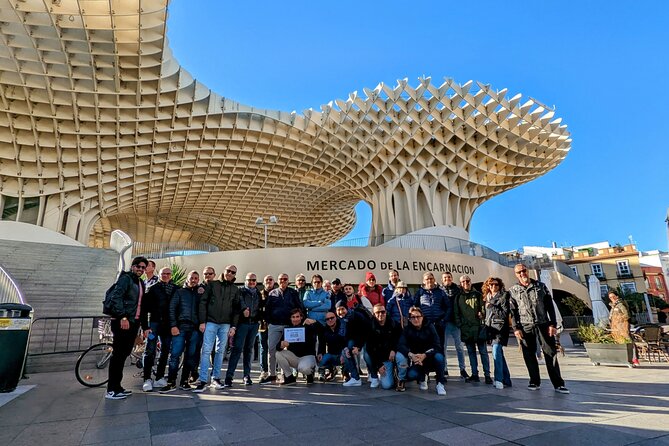
One of the most impressive stops is the General Archive of the Indies. You’ll view it from the outside, but the stories connected to it are specific: more than 40,000 documents related to America are kept here, including maps, the document of the Treaty of Tordesillas, and autograph texts of Christopher Columbus.
This is the stop that turns architecture into context. You begin to understand how empires ran on information, not only ships. The Archive is UNESCO-protected, and it gives the tour a “real-world impact” angle that’s easy to remember after you leave.
Because it’s an exterior stop, you won’t spend time inside reading documents. But you’ll walk away with a clear sense of why Seville matters to the history of the Americas.
Real Alcázar exteriors: kings, mudéjar style, and Dorne
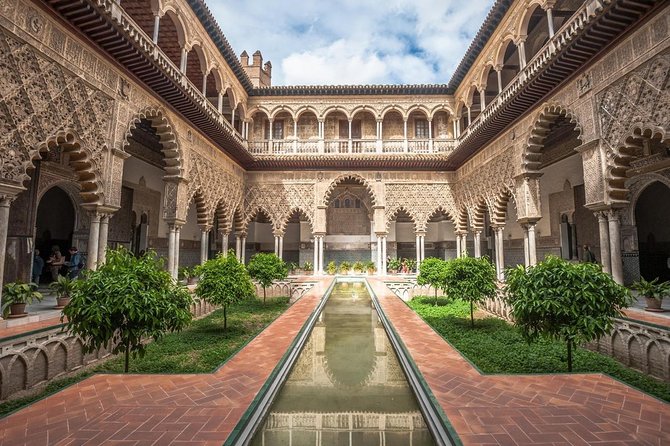
You then reach the Real Alcázar, another UNESCO site. The guide frames it as the oldest royal palace in Europe still in use, which is a helpful way to understand why it doesn’t feel like a frozen museum.
You’ll see the palace exteriors and hear stories about the kings who lived here. And yes, there’s a Game of Thrones link too: Dorne was filmed at the Alcázar.
Even from the outside, this helps because Seville’s palace style is part Islamic, part European, shaped by time and rulers. The tour is good at pointing out how that mix shows up in details, so you’re not just admiring walls—you’re learning how walls tell stories.
Practical note: this section can feel like the “main event” of the day. Pace yourself. If you’ve been in sun, take your first real shade break here if the guide offers it.
Santa Cruz walking: the old Jewish Quarter with patios and opera references
After the palace, you move into the Barrio de Santa Cruz, Seville’s old Jewish Quarter. This part turns the tour from landmark spotting into neighborhood walking, which is exactly what I want from a half-day: your feet meet the city’s texture.
This area is known for charming squares, tight alleys, and patios with flowers. The guide highlights notable places like Doña Elvira, Los Venerables, Agua y Vida, and Plaza de Santa Cruz.
You’ll also hear cultural notes connected to opera, including the Barber of Seville reference. It’s a nice reminder that Seville’s arts aren’t separate from its streets; they’re tied to the way people lived in these quarters.
This is also the section where comfortable shoes pay off. Even if you’re not going far, you’ll be turning corners and navigating uneven old streets. If you’re moderate-fit, this is doable, but don’t plan to wear brand-new shoes.
Giralda one more time, plus City Hall: how Seville looks at different angles
After Santa Cruz, you get another outside look at the Giralda. Seeing it twice in one tour isn’t redundant—it’s useful. A second view helps you register the tower’s scale and its relationship to nearby buildings.
Then you head to the Seville City Hall, built in the 16th century in the era of Emperor Carlos V. It’s a Renaissance architecture highlight that reflects Seville’s prosperity at a time when the city was the port and gateway to America.
This stop is great for understanding how money changes a skyline. You can almost feel the city telling visitors and locals: we’re powerful now.
Church of El Salvador: from first mosque to collegiate church and preserved courtyard
The tour includes the Church of El Salvador from the outside. It has a long timeline: originally the first mosque in Seville in the 9th century, later transformed into a collegiate church in the 13th century during Fernando III el Santo.
A practical detail you’ll learn is that it preserves an old ablution courtyard from the mosque. That makes the stop more than a name on a map. It shows how religious practices can leave physical marks that survive through regime change.
You’ll also hear about the surrounding commercial life. The church is surrounded by shops because it was in the center of the medina in Islamic times. In other words, commerce wasn’t a separate layer—it was part of daily life around sacred spaces.
Metropol Parasol mushrooms (Setas) and Calle Sierpes: Seville’s modern twist and a Cervantes link
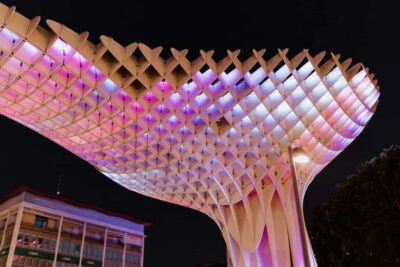
Next you walk through the older medina streets, now the city’s commercial area, heading toward Plaza de la Encarnación. Here you’ll see the famous mushrooms: the Metropol Parasol or Setas de Sevilla.
The guide connects this to modern design by noting the architect, Jürgen Mayer, and how the structure became one of Seville’s major symbols. Even if you’re not a modern architecture fan, it helps you see how Seville makes room for new icons without erasing the old ones.
Then you reach Calle Sierpes, one of the best-known streets. It’s a shopping and café street, but you’ll also learn about a historical detail: the street area includes the old Royal Prison, where Miguel de Cervantes was a prisoner.
That’s a great trick for this kind of walking day. You get to enjoy the street for what it is now, but with a second layer of meaning that doesn’t require museum tickets.
Ending at Plaza de San Francisco: the heart of Seville within walking reach
Your tour finishes in Plaza de San Francisco, close to the Cathedral and in the heart of Seville. The end point matters because it drops you near places you’ll likely want to explore on your own after the tour.
This is a smart finish for two reasons. First, you’ll have your bearings for navigating back into the Cathedral area. Second, you’ll be positioned for a meal or a final wander without doing extra long walks.
At the end of a 2 to 3 hour route, you should feel like you’ve been given a key—not a checklist. This itinerary is built to give you context so Seville starts making sense quickly.
Price and value: what $133 gets you (and what it doesn’t)
At about $133.03 per person for a 2 to 3 hour private walking tour, you’re paying for three things: an experienced official guide, a focused route that hits major landmarks fast, and included tour photos.
What you’re not buying is long museum time or interior access. The itinerary is mostly exterior views, which can be a plus if your priority is orientation and stories rather than tickets and slow lines. For first-time visitors, that can be excellent value: you cover a lot of Seville’s big themes without spending your entire day waiting.
The private element also helps if you’re traveling as a family or small group that wants questions answered in real time. It also lists group discounts, so if you’re booking with others, you may find the overall cost easier to justify.
If you’re on a tight schedule, this tour is a practical way to get the city’s “how it all connects” picture before you branch out on your own.
Who this tour fits best
This works especially well if you want a guided walk that blends architecture, empire history, and neighborhood feel. It’s also a strong pick if you like your sightseeing explained with humor and clear storytelling—Carlos and Fernando are highlighted for being personable and fun in a way that makes the hours pass.
You’ll want moderate physical fitness because you’ll be moving between several areas on foot. If you’re sensitive to heat, plan for it and lean on the guide’s comfort-minded approach, like shade and bathroom awareness.
You might also enjoy this more if you’re visiting for the first time and want a route that naturally creates a mental map. If you already know Seville well and want deep interior access, you may find the exterior-heavy structure less satisfying.
Should you book? My straight answer
Book this tour if you want to get your bearings in Seville fast and you’d rather understand the city than just photograph it. The combination of major landmarks, strong guiding, and included photos makes it a solid value for the time you spend.
Skip it or consider a different style of tour if your top goal is spending lots of time inside museums and churches. This one is designed for walking, seeing, and learning the connections between places.
If you come expecting a smart, story-driven city tour with a guide who keeps things comfortable, you’ll likely have a very good half-day.
FAQ
How long is the Seville private half-day walking tour?
It’s listed as approximately 2 to 3 hours.
Where does the tour start and where do you finish?
The tour starts at Puerta de Jerez and ends at Plaza de San Francisco.
Is this a private tour or a shared group?
It’s a private tour/activity, so only your group participates.
What language is the tour offered in?
The guide offers the tour in English.
What’s included in the price?
Included items are an official professional Seville guide and tour photos.
Is transportation included?
No. Private transportation is not included.
How physically demanding is the walking?
It’s best for travelers with moderate physical fitness since it’s a walking tour.
Are service animals allowed?
Yes. Service animals are allowed.
What happens if the weather is poor?
The experience requires good weather. If it’s canceled due to poor weather, you’ll be offered a different date or a full refund.
Is free cancellation available?
Yes, there is free cancellation if you cancel at least 24 hours in advance for a full refund.
More Tour Reviews in Seville
- Seville: Live Flamenco Dancing Show Ticket at the Theater
★ 4.7 · 16,396 reviews - Seville: Alcázar, Cathedral & Giralda Skip-the-Line Tour
★ 4.8 · 11,525 reviews - Seville: 1-Hour Guadalquivir River Sightseeing Eco Cruise
★ 4.2 · 10,281 reviews - Seville: Setas de Sevilla Entry Ticket
★ 4.6 · 8,901 reviews - Seville: Cathedral, Giralda & Alcazar Entry With Guided Tour
★ 4.6 · 8,560 reviews
A Guide of Your Own in Seville
- Seville: Private City Tour by Eco Tuk Tuk
★ 4.8 · 963 reviews - Seville Private Walking Tour with Alcazar & Cathedral Tickets
★ 5.0 · 332 reviews - Private Walking Tour Alcazar and Cathedral in Sevilla
★ 5.0 · 172 reviews - Alcazar and Cathedral of Seville Private Tour
★ 5.0 · 149 reviews - Private Tour Jewish Quarter, center and Plaza de España
★ 5.0 · 127 reviews
More Walks Through the Old Town
- Seville: Small-Group City Highlights Walking Tour
★ 5.0 · 1,204 reviews - Cultural Walking Tour of Seville Monumental
★ 5.0 · 861 reviews - Seville: Tapas, Taverns, and History Walking Tour
★ 4.9 · 676 reviews - Seville: Tapas, Taverns and History Guided Walking Tour
★ 4.9 · 515 reviews - Seville: Small-Group Jewish Quarter Discovery Walking Tour
★ 4.9 · 499 reviews
Just added to the Seville list



Seville Old Town Walks, compared.
 ★ 5.0Small-Group City Highlights Walking TourFrom $271,204 reviews
 ★ 5.0Cultural Walking Tour of Seville MonumentalFrom $8861 reviews
 ★ 4.9Tapas, Taverns, and History Walking TourFrom $84676 reviews
 ★ 4.9Tapas, Taverns and History Guided Walking TourFrom $99515 reviews
 ★ 4.9Small-Group Jewish Quarter Discovery Walking TourFrom $29499 reviews
 ★ 5.0Seville Guided Small-Group Walking TourFrom $21435 reviews
 ★ 4.7Paranormal and Legends Guided Walking TourFrom $15336 reviews
 ★ 5.0Seville Private Walking Tour with Alcazar & Cathedral TicketsFrom $276332 reviews
Browse the lists this tour appears in