
Review · SEVILLE BIKE TOURS
Guided Bike Tour of Seville with a Certified Guide
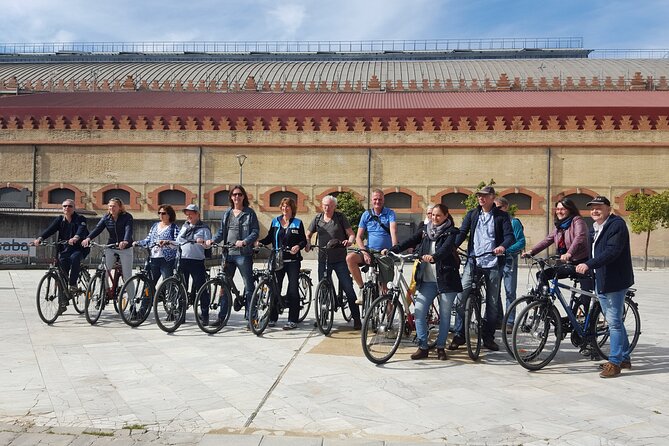
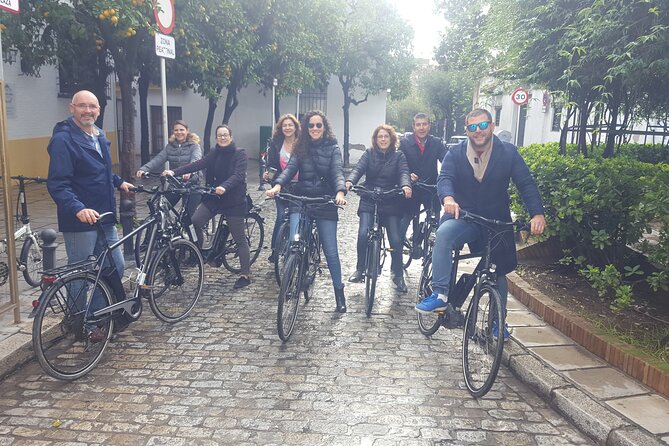
There is no faster way to get your bearings. This guided Seville bike tour strings together major landmarks in a short ride, with time to hop off for photos and quick walks. I especially liked the small group size (max 15) and the way guides like Rigo and Pablo keep the facts clear and actually useful. One thing to consider: you’ll be moving most of the time, so if you want long museum-style stops, this may feel short.
I love that the route covers the “big three” UNESCO hitters—Seville Cathedral, the Real Alcázar, and the Archivo de Indias area—without forcing you into a full day of ticket lines. The bike format also means you see more than you could comfortably on foot in 2 to 2.5 hours. The pace is meant for most people who can handle a bike, but it’s still a ride.
Price is $36.12 per person for about 2 to 2.5 hours, booked often in advance. That cost can be a great value here because you’re paying for time efficiency plus a certified guide—especially when Seville’s sights are spread across different neighborhoods along the river.
In This Review
- Key Highlights You’ll Feel Right Away
- Getting Oriented Fast on Two Wheels
- Parque de María Luisa: A Green Start Between Palaces and History
- Triana Bridge (Isabel II Bridge): The River Cross That Changes the Story
- Plaza de España: The 1929 Exposition Showpiece
- Seville Cathedral: Gothic Power, Mosque Roots
- Real Alcázar: Royal Palace That Still Lives Today
- Giralda Tower: The Famous Weathervane That Points to Faith
- Plaza Nueva and the Town Hall: Plateresque Detail You Might Miss on Foot
- Torre del Oro: The River’s Watchtower and Naval Museum
- Price and Value: Why $36.12 Works Here
- Who This Tour Fits Best
- Should You Book This Seville Bike Tour?
- FAQ
- How long is the guided bike tour of Seville?
- What’s the meeting point for the tour?
- Is the tour offered in English?
- How large is the group?
- Is admission included for stops?
- Can I cancel for free?
Key Highlights You’ll Feel Right Away
- Bike-friendly city flow: you move between parks and monuments without the “how do I get there” hassle
- Hop-off moments for photos and quick walks: enough time to reset without burning the whole tour
- Standouts from UNESCO core sights: Cathedral and Alcázar viewpoints plus the famous Giralda tower area
- A guide who explains, like Rigo and Pablo: clear English with the details that make the buildings make sense
- Iconic river landmarks included: Triana Bridge and the Torre del Oro add strong variety
- Budget-friendly stops where noted as free: parks and plazas with admission-free time
Seville by bike, a few more routes
- Seville Highlights Bike Tour (English)★ 5.0 · 2,225 reviews
- Seville: Highlights City Bike Tour★ 4.8 · 2,168 reviews
- Seville: Relaxing City Bike Tour with a Tour Guide★ 4.8 · 1,588 reviews
Getting Oriented Fast on Two Wheels
Seville can hit you all at once: heat, stone, churches, patios, river views, and street life that seems to run on its own schedule. A bike tour works because it gives you a clean sequence of “where am I, what am I looking at, why does it matter?” without you needing to build the day yourself.
The ride length is short—about 2 hours to 2.5 hours—so the experience feels like a smart first-day tool. You’re not signing up for a long cycling workout. More like: set off, see the big calls, learn the story beats, then go back out on your own with better instincts.
Guides play a huge role in tours like this, and the feedback you’ll want to take seriously here is that Rigo and Pablo are consistently praised for pacing and explanation in excellent English. That matters because Seville’s landmarks can look similar at a distance if you don’t know what to notice (Gothic lines here, Moorish influence there, 19th-century changes elsewhere).
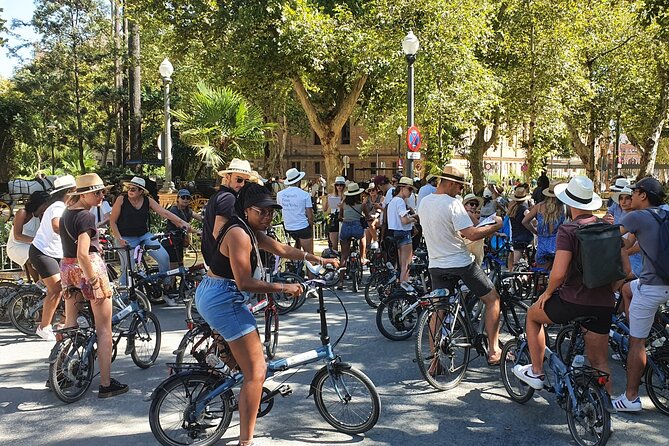
Also, the tour caps at 15 travelers, which usually means fewer bottlenecks at stops and a more human feel when questions come up.
Parque de María Luisa: A Green Start Between Palaces and History
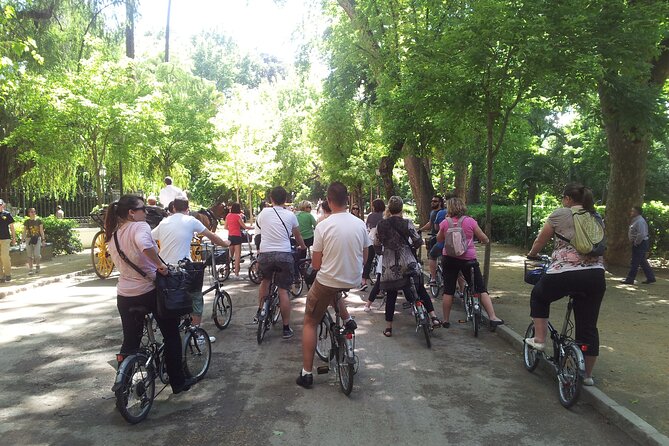
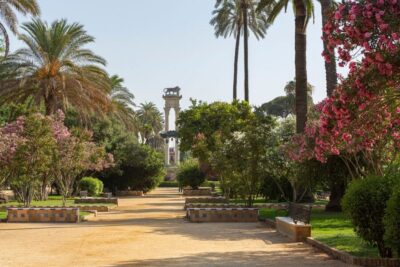
The ride begins at Parque de María Luisa, Seville’s “big lung.” Even if you’ve never been, you can understand the vibe fast: it’s spacious, designed for strolling, and it gives you relief from the feeling of being surrounded by monuments.
You get about 30 minutes here, with the benefit that this stop is marked free for admission. The park is tied to the Palace of San Telmo area and the setting of the Ibero-American Exposition of 1929. That connection is more than trivia. It helps you see the park as part of Seville’s planned, ceremonial face—not just random greenery.
What I like about starting here is the rhythm. You start in a calm place, then you gradually move toward denser architecture: bridges, plazas, and the grand religious and royal sites later. It’s a logical progression, and it also reduces jet-lag friction. If your legs are still waking up, this is a gentle “warm-up” stop.
Possible drawback? If you’re the type who wants to sit for a long time and people-watch for an hour, 30 minutes may feel brief. But for a guided tour format, it’s a strong opening.
Triana Bridge (Isabel II Bridge): The River Cross That Changes the Story
After the park, you head to Isabel II Bridge, often called the Triana Bridge. It crosses the Guadalquivir River and connects central Seville to Triana—and that neighborhood swap matters. Triana is where the city feels more local, more lived-in, and less “official museum postcard.”
This bridge replaced an older boat bridge and was completed in 1852, under the reign of Isabel II—which is exactly why it carries her name. It’s also noted as the oldest preserved iron bridge in Spain. That’s the kind of detail a bike guide can point out quickly so you don’t just read the bridge as scenery.
There’s another practical reason to include a river crossing: the river is Seville’s compass. When you understand where the Guadalquivir runs, planning later days gets easier—whether you’re chasing sunset photos or hunting for tapas.
You’ll likely get a short stop here for orientation and photos, not a deep dive. If you want to linger for dramatic river views, you can do that after the tour, once you know exactly where you are.
Still deciding? A few more Seville picks worth a look.
Plaza de España: The 1929 Exposition Showpiece
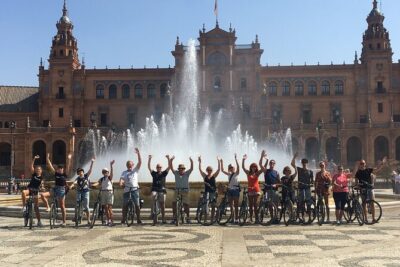
Next up is Plaza de España, located in María Luisa Park, designed by architect Aníbal González, and built between 1914 and 1929 for the Ibero-American Exposition of 1929. This is one of those places where you feel the scale even before you understand the details.
Your time here is about 15 minutes, and it’s listed as free. That short window can sound tight, but it’s honestly enough for the “first impression” payoff: you can take in the sweeping horseshoe layout, the energy of the space, and the sense of grand planning.
Why this stop works on a bike tour is simple. Seville has lots of major landmarks, but Plaza de España gives you a different kind of architecture—less about religious power, more about state-building and spectacle. Knowing that it was built for a world exposition makes the design choices easier to read.
If you’re a photographer, 15 minutes is still useful. Just don’t expect to capture every corner. Use it to get your bearings and then come back later on your own when you have time to chase reflections and details.
Seville Cathedral: Gothic Power, Mosque Roots
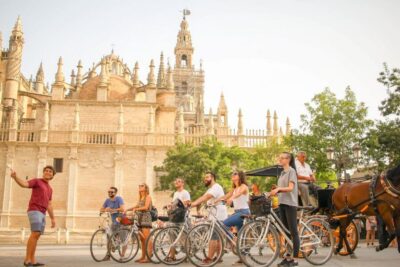
Then the tour shifts into the big monument territory: Seville Cathedral (Santa María de la Sede y de la Asunción de Sevilla), the Gothic church that’s one of the largest in its style in the world. The cathedral was recognized by UNESCO in 1987, together with the Real Alcázar and the Archivo de Indias as a World Heritage Site.
Here’s what I’d focus on while you’re there: the cathedral sits on the historical footprint of the old Aljama of Seville mosque. The guide can help you connect that past to what you can still see today—especially because the Giralda minaret and the Patio de los Naranjos are preserved. That link turns the cathedral from “big church” into a layered, moving story of Seville’s changing rulers.
Construction is traditionally said to begin in 1401, with documentary evidence starting around 1433. You don’t need to memorize dates, but you’ll understand why the building feels both massive and exact—Gothic work that took real time.
Since this is a bike tour with a limited total duration, you should expect “sight stop” time rather than a long interior visit unless the schedule you booked includes it. Still, even from the outside, Seville Cathedral tells you a lot about the city’s priorities.
Real Alcázar: Royal Palace That Still Lives Today
Right near the cathedral zone is the Real Alcázar of Seville, a palace complex built in stages across centuries. This is where you start seeing how Seville blends Islamic, Gothic, and later European styles.
What makes the Alcázar stand out is that it preserves Islamic art vestiges and includes Mudejar palatial spaces, then adds Gothic, and later Renaissance, Mannerist, and Baroque elements. In other words: the palace isn’t one style frozen in time. It’s an evolving royal canvas.
The tour info also highlights the Outer wall and Lion gate, and the fact that the Alcázar is still used when members of the Spanish royal family visit Seville. That detail is not just romantic. It’s practical context. If a place is still actively used, the complex often retains a certain formality and “kept” feel compared with sites that are purely museum relics.
This is also the oldest royal palace in use in Europe, and it’s UNESCO-listed with the cathedral and the Archivo de Indias (recognized in 1987). As a scale marker, the Alcázar drew 2,067,016 visitors in 2019, which explains why it’s so famous and why planning matters when you go back later.
On a bike tour, the advantage is that you get the orientation so your future visit makes sense. You’ll know where the palace connects to the cathedral zone and how the surrounding layout supports the “royal center” idea.
Giralda Tower: The Famous Weathervane That Points to Faith
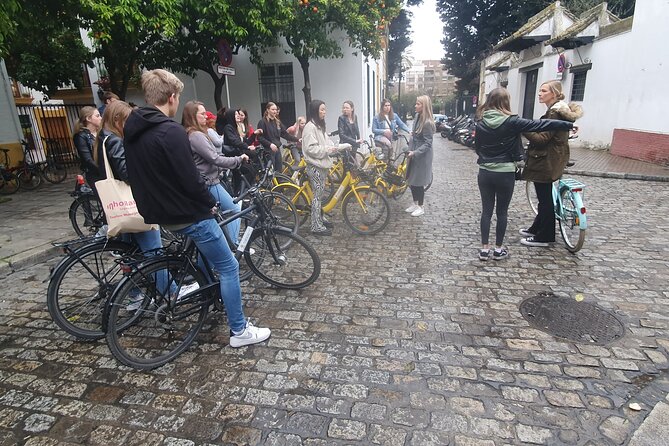
No Seville highlights list is complete without Giralda, the bell tower of the cathedral. The key detail you want your guide to point out is the mixed origin: the lower tower corresponds to the old city mosque’s Almohad minaret from the end of the 12th century, while the upper portion is a later 16th-century Christian construction.
Giralda’s height is listed at 94.69 meters, and at the top you’ll find the Giralaldillo, a bronze statue representing the Triumph of Faith that functions as a weathervane. That’s a wonderfully Seville detail: even the symbolism is practical. Weather affects it, so it isn’t just decoration—it’s part of the building’s daily life.
The cathedral complex was declared a National Monument in 1928 (including the Giralda), and UNESCO recognized the cathedral with its tower in 1987 as part of the World Heritage framework.
In a short bike tour, your best move is to treat Giralda as your “vertical landmark.” When you look up later on your own, you’ll orient quickly. It’s the kind of tower that makes you feel like you’re holding the city in your pocket.
Plaza Nueva and the Town Hall: Plateresque Detail You Might Miss on Foot
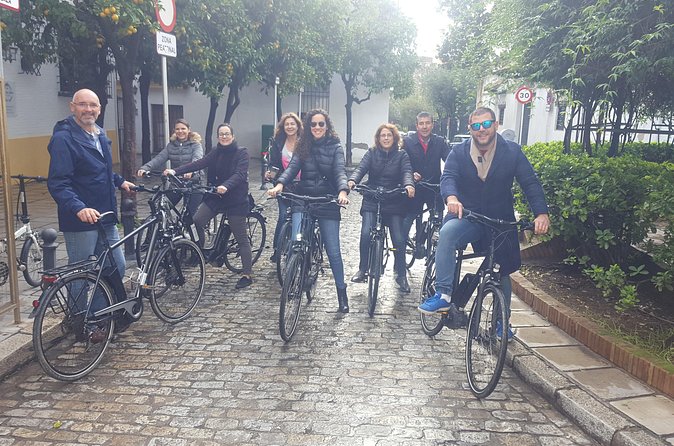
Another stop is Plaza Nueva and the town hall building with its Renaissance architecture described as Plateresque, known for minute decoration. This isn’t just a random civic building. It’s a clue to how Seville expresses power outside the church walls.
The construction started in the 16th century under master Diego de Riaño, focusing on the southern sector and key areas like the Chapter House, the old staircase, and the Hall of Faithful Executors, plus a communication arch with the Franciscan monastery. Later, in the 19th century, it was enlarged by Demetrio de los Ríos and Balbino Marron, who also designed a new main facade in a neoclassical style oriented to Plaza Nueva.
On a bike tour, you won’t have time to study every relief. But you can still learn what to look for: that lace-like stone carving style that earned the Plateresque label. If you return on a future day and pause here, you’ll notice the details much faster because you’ll know the style.
Torre del Oro: The River’s Watchtower and Naval Museum
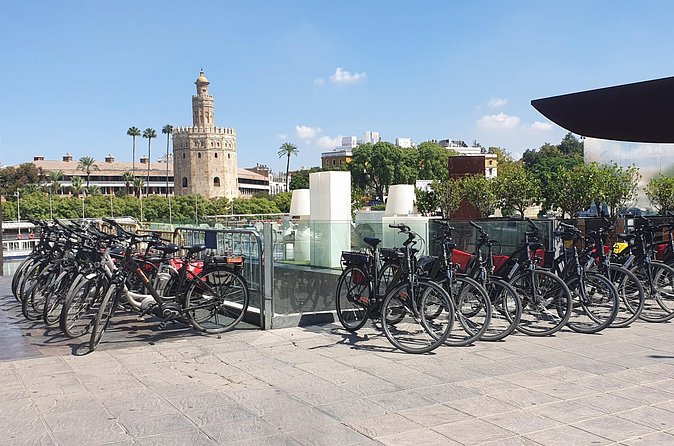
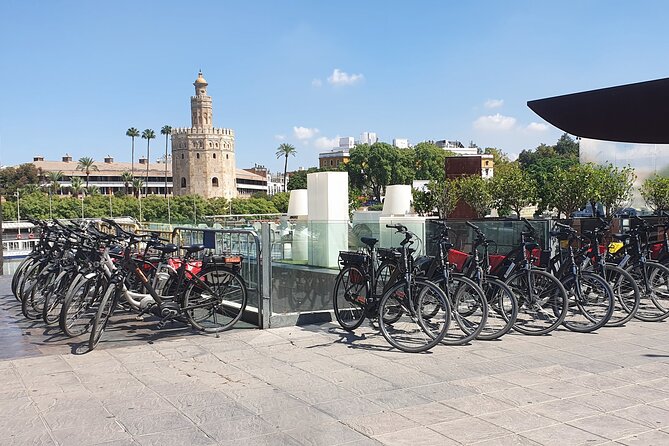
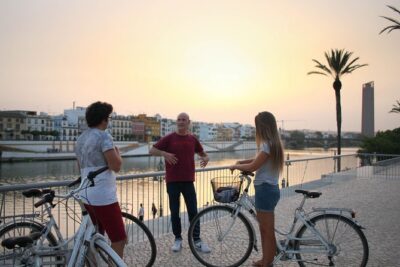
To round out the tour, the route includes Torre del Oro (Tower of Gold), a watchtower on the left bank of the Guadalquivir River in the Arenal area. It stands about 36 meters high and dates to 1221, with construction ordered by the Almohad governor Abù l-Ulà.
This tower is a strong contrast to the religious and royal stops: instead of spiritual or ceremonial purpose, it’s defensive and strategic. It was declared a historic-artistic monument in 1931, and it has been restored multiple times—includes repairs by the Navy and restorations in later years.
The tower currently houses the Naval Museum of Seville (as noted in the tour info). Even if you don’t enter during your bike tour, seeing the building tells you how the river shaped Seville’s economy and power.
If Triana is on your mind, Torre del Oro ties it together. It sits opposite Triana across the water, so you get that “two sides of the same city” feeling.
Price and Value: Why $36.12 Works Here
At $36.12 per person, this isn’t a bargain in the way a free self-guided stroll is. But it’s also not trying to compete with full-day tour prices. For what you get—certified guidance, an English-speaking guide, and a concentrated route linking key Seville icons in about 2 to 2.5 hours—it can represent strong value.
Here’s where the math works in real life:
- You’re buying time. Seville’s major sites aren’t all next door to each other.
- You’re buying context. Good guides (especially Rigo and Pablo, based on what you’ll hear in the tour) help you spot what matters instead of just staring at stone.
- You’re buying effort reduction. Bikes help you move efficiently without getting stuck in “transit brain” for every hop.
The main trade-off is that some of the stops are short. You won’t get the kind of lingering you’d want at a standalone cathedral or palace visit. But that’s also the point: this tour is a first-pass way to set direction. Then you pick what to go deeper on afterward.
Who This Tour Fits Best
This guided bike tour of Seville is a good match if you:
- want a first day introduction to the city
- enjoy monuments but don’t want a full walking marathon
- like learning the “why” behind what you’re seeing
- prefer a small group experience (up to 15)
It may be less ideal if you:
- need very slow pacing and long stops
- are uncomfortable riding a bicycle for most of the tour duration
- want interior-only museum time rather than guided sight stops
Still, the reviews emphasize an easy pace and friendly guidance, which suggests the ride portion is meant to be manageable for most visitors who can bike.
Should You Book This Seville Bike Tour?
If you’re deciding what to do with limited time, I’d strongly consider booking. This tour hits the high-impact sights—Parque de María Luisa, Plaza de España, Seville Cathedral, the Real Alcázar zone, Giralda, plus Triana Bridge and Torre del Oro—in a tight, efficient format. You’ll leave with a map in your head and names you can attach to what you see later.
Book it if you want: orientation + guided context + a smooth first taste of Seville. Skip it only if you’re seeking long, unhurried museum time, because the schedule is designed for motion and quick stops.
If you want, tell me your travel month and fitness level. I can suggest the best time of day to do this (so you’re not cooking during the ride) and which sights to prioritize afterward.
FAQ
How long is the guided bike tour of Seville?
It runs about 2 hours to 2 hours 30 minutes.
What’s the meeting point for the tour?
The tour starts at Spain Cycling Tours, C. San Jorge, 23, 41010 Sevilla, Spain.
Is the tour offered in English?
Yes, the tour is offered in English.
How large is the group?
The maximum group size is 15 travelers.
Is admission included for stops?
Some stops are listed as free with admission tickets (for example, Parque de María Luisa and Plaza de España). Other major sights are described as part of the route, but the data only explicitly notes free admission for those specific stops.
Can I cancel for free?
Yes. Free cancellation is available up to 24 hours in advance for a full refund.
More Tours in Seville
- Seville: Alcázar, Cathedral & Giralda Skip-the-Line Tour
★ 4.8 · 11,525 reviews - Seville: Cathedral, Giralda & Alcazar Entry With Guided Tour
★ 4.6 · 8,560 reviews - Seville: Priority Access Cathedral, Giralda & Alcázar Tour
★ 4.8 · 7,563 reviews - Seville: Alcázar and Cathedral Entry Ticket and Guided Tour
★ 4.6 · 5,056 reviews - Seville: City Sightseeing Hop-On Hop-Off Bus Tour
★ 4.0 · 4,633 reviews
More Tour Reviews in Seville
- Seville: Live Flamenco Dancing Show Ticket at the Theater
★ 4.7 · 16,396 reviews - Seville: Alcázar, Cathedral & Giralda Skip-the-Line Tour
★ 4.8 · 11,525 reviews - Seville: 1-Hour Guadalquivir River Sightseeing Eco Cruise
★ 4.2 · 10,281 reviews - Seville: Setas de Sevilla Entry Ticket
★ 4.6 · 8,901 reviews - Seville: Cathedral, Giralda & Alcazar Entry With Guided Tour
★ 4.6 · 8,560 reviews
Pedalling Round Seville
- Seville Highlights Bike Tour (English)
★ 5.0 · 2,225 reviews - Seville: Highlights City Bike Tour
★ 4.8 · 2,168 reviews - Seville: Relaxing City Bike Tour with a Tour Guide
★ 4.8 · 1,588 reviews - Seville: City Sightseeing and Local Culture Bike Tour
★ 4.9 · 1,120 reviews - Seville Electric Bike Tour – Small Group
★ 5.0 · 841 reviews
Just added to the Seville list


Seville Bike Tours, compared.
 ★ 5.0Seville Highlights Bike Tour (English)From $422,225 reviews
 ★ 4.8Highlights City Bike TourFrom $382,168 reviews
 ★ 4.8Relaxing City Bike Tour with a Tour GuideFrom $351,588 reviews
 ★ 4.9City Sightseeing and Local Culture Bike TourFrom $311,120 reviews
 ★ 5.0Seville Electric Bike Tour – Small GroupFrom $58841 reviews
 ★ 5.0Sunset Guided Bike Tour in SevilleFrom $36438 reviews
 ★ 4.9Guided Sunset Bike TourFrom $41332 reviews
 ★ 5.03-hour Guided Bike Tour along the Highlights of SevilleFrom $39315 reviews
Browse the lists this tour appears in