
Three icons, one killer skyline view. This tour bundles the Royal Alcázar with Seville’s Cathedral and the Giralda into one tight loop, so you see the city’s biggest visual hits without guessing where to start. I love how the Royal Alcázar’s gardens and courtyards connect centuries of power and style, and I also love the Cathedral’s sheer size plus the Giralda climb for city views. The only real watch-out: it’s a shared tour with a brisk pace, so don’t count on long photo stops.
You get an official English guide, tickets for all three sights, and a mobile ticket plan that keeps the day moving. Expect about 3 hours total, and note the tour may start 10–20 minutes after the listed time to organize groups, with the order of monuments occasionally adjusted. If you hate crowds, or you travel with a big bag, plan accordingly.
In This Review
- Key highlights you’ll feel right away
- Getting the big picture: UNESCO Seville in about 3 hours
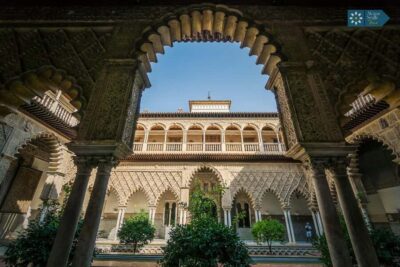
- Royal Alcázar: gardens, courtyards, and the layers of rule
- Seville Cathedral: scale, Columbus, and what to spot quickly
- Climbing the Giralda: the minaret story and the best views
- Price and value at $147.87: what you’re really buying
- Group size, pacing, and practical rules you should know
- Who this tour fits best (and who should skip)
- Before you go: simple moves that make the day smoother
- Should you book this Seville icons tour?
- FAQ
- How long is the tour?
- What’s included in the price?
- Is the tour private?
- What language is the tour offered in?
- Where does the tour start?
- Where does the tour end?
- Do I need ID?
- Is there a dress or bag restriction?
- When does the tour start relative to the listed time?
- How does cancellation work?
Key highlights you’ll feel right away
- Three UNESCO sites in one guided route: Royal Alcázar, Cathedral, and the Giralda
- Tickets handled for you so you’re not stuck at separate counters
- Royal Alcázar’s style shifts from Roman roots to Mudéjar, Gothic, Renaissance, and Baroque details
- Cathedral scale that hits fast—including the Columbus tomb inside
- Giralda climb for panorama views from Seville’s most famous tower
- Shared-group pace designed to cover a lot in about 3 hours
More ways through the Alcazar gates and gardens
- Seville: Cathedral, Giralda & Alcazar Entry With Guided Tour★ 4.6 · 8,560 reviews
- Seville: Priority Access Cathedral, Giralda & Alcázar Tour★ 4.8 · 7,563 reviews
- Seville: Alcázar and Cathedral Entry Ticket and Guided Tour★ 4.6 · 5,056 reviews
Getting the big picture: UNESCO Seville in about 3 hours
Seville can feel endless when you try to do the icons on your own. This tour gives you structure: you hit the Alcázar, the Cathedral, and the Giralda as a set, which is the best way to understand how the city’s power and faith shaped its architecture.
You’re looking at a UNESCO trio where the story repeats in different ways—imperial and religious authority, Islamic-era influence, then later Christian and European layers. That context matters, because these monuments can look like just “beautiful buildings” until someone explains what you’re actually seeing.
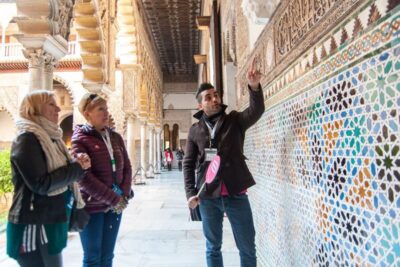
The format is also practical. You’re with an official English guide, you’re not responsible for figuring out routing, and you’re not bouncing between separate ticket processes. It’s also a shared tour (max 100 travelers), so you’ll move in a group rhythm—fast enough to be efficient, not so slow that you can leisurely wander at will.
Royal Alcázar: gardens, courtyards, and the layers of rule
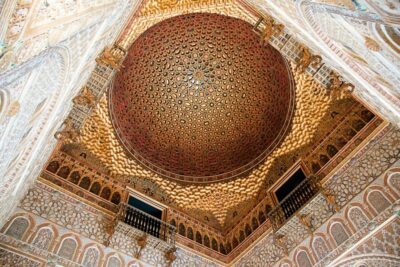
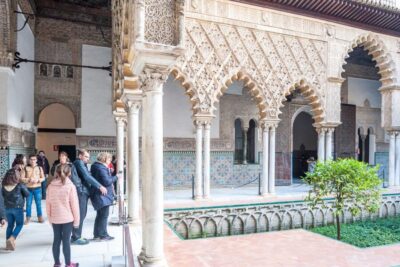
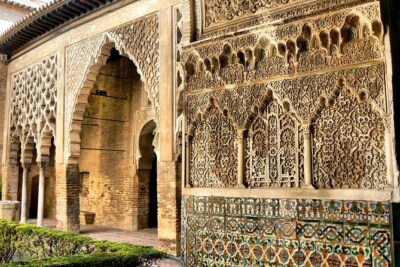
The Royal Alcázar is the kind of place where you can’t really rush it. This palace complex grew over time, starting with Roman construction, then changing hands with Visigoths, and later becoming a fortress under Moorish rule. The result is a mash-up you can literally walk through: Mudéjar details, plus Gothic, Renaissance, and Baroque influences showing up in different parts of the complex.
What I love most is how the palace doesn’t just show off rooms. It shows off outdoor space—gardens and courtyards—where light, tilework, and symmetry do real storytelling. You’ll get that “wait, look at that” feeling when you notice how decorative elements repeat and shift depending on the era.
One useful way to enjoy the Alcázar is to pick two things to focus on during the visit: first, the decorative details, and second, the way the courtyards and gardens are designed to guide your movement. When you do that, you’ll feel like you’re reading the place instead of just photographing it.
The pace here is designed to cover the highlights, not to satisfy deep-studies mode. If you’re the type who loves slowing down for every inscription or tile pattern, you might want extra solo time later. Still, as part of a 3-hour “icons” day, this stop gives you the big visual and historical payoff.
Seville Cathedral: scale, Columbus, and what to spot quickly
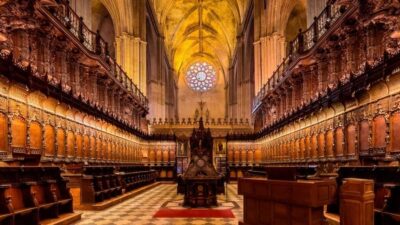
Next comes the Cathedral of Seville, one of Europe’s heavyweights. It’s the seat of the Archdiocese of Seville, and it’s the largest Gothic cathedral in the world. The numbers alone are wild: it measures about 126 meters long, 76 meters wide, and 42 meters high—so your brain needs a second to recalibrate when you walk inside.
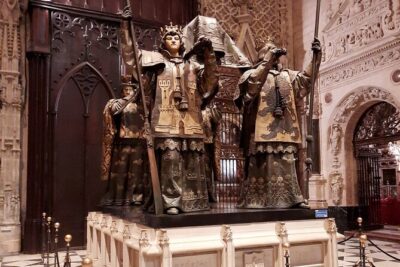
This monument is also famous for what it contains, not just how it looks. You’ll see the tomb of Christopher Columbus, and you’ll have a chance to take in the ornate main altar. The scale plus the treasures create a powerful contrast: a building meant to impress, filled with objects meant to matter.
If you want to make the most of your time here, don’t aim for everything. Aim for one “big view” moment when you first enter, then focus on one key detail—like the main altar area or the Columbus tomb—before you start drifting toward the most photogenic corners.
Also, remember this stop is part of a timed, guided sequence. That means you’ll get good context, but the day may not pause for every photo angle. If you travel with camera gear or you like long stops, keep it light and quick so you don’t get left behind.
Other climbs up the Giralda and walks round the Cathedral
Climbing the Giralda: the minaret story and the best views
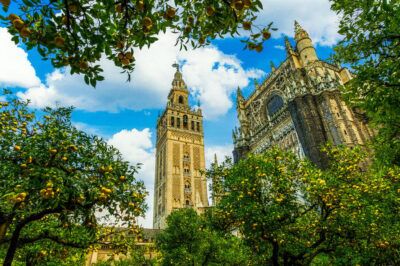
The Giralda is the part of the day that often becomes the “oh, this is why I booked” moment. It started life as the minaret of the Great Mosque of Seville, and later it became the cathedral’s bell tower. That blend of Islamic-era design plus later Renaissance additions is visible in the structure, and it helps connect the earlier stops into one ongoing story.
The tower’s height is about 94.7 meters, so you feel it in the city even before you reach it. Then the climb gives you something most ground-level sightseeing can’t: perspective. From up there, you understand why Seville is laid out the way it is—streets, roofs, and monument shapes all line up into a readable map.
This is where planning pays off. Wear shoes you’re comfortable walking in and climbing with, and expect a structured experience rather than free-ranging time on every landing. The goal is to get you to the viewpoints without turning the climb into a long delay for the group.
The Giralda also ties the UNESCO meaning together. You’re not just looking at separate attractions; you’re looking at one historical complex that transformed with changing rulers and religions. When you climb, you’re literally moving through that transformation in height and form.
Price and value at $147.87: what you’re really buying
At $147.87 per person for about 3 hours, the value comes from the bundle: an official English guide plus tickets for the Royal Alcázar, the Cathedral, and the Giralda. That combination matters in Seville, where these top sites are too big and too important to treat like casual stops.
So instead of spending your mental energy on ticket logistics and figuring out what to prioritize, you’re paying for interpretation and access. You’re also paying for time efficiency—the tour is built to cover three major monuments in a compact window.
One more value point: the order of visits can change due to operational reasons. That flexibility is useful because it means the provider is thinking about how to keep the day running instead of forcing a rigid route that might break under real-world conditions.
The main cost consideration is the shared-group format. If you want a private, slow-motion experience where you can linger for 20 minutes at one chapel or one corner of the garden, you’ll likely feel the limits. But if you want a solid overview of the icons and you’re happy to follow a guide’s flow, this price starts to look very reasonable.
Group size, pacing, and practical rules you should know
This is a shared tour for up to 100 people, with a guide leading the group in English. That size can still feel manageable because the monuments are huge, but it does influence how much flexibility you have. The rhythm is efficient, and it’s common for the experience to move with minimal waiting for every photo.
There are also a few rules that affect your comfort level. Backpacks aren’t allowed, so plan for a small bag only. You also need to bring passport or ID, since it’s required for entry.
Timing is another small detail that can matter. The tour starts around 10–20 minutes after the established schedule to organize the groups. In practice, it means you should arrive near the meeting point early, not at the last minute.
Speaking of the meeting point, it’s Av. de la Constitución, s/n, in the Casco Antiguo area. The tour ends back at the meeting point, so you’re not stranded across town when it’s over.
Who this tour fits best (and who should skip)
I think this tour is a great match if you want a guided “icons day” without overplanning. It works well for first-timers who need context fast, and it also works for repeat visitors who want a clean overview that connects the Cathedral and Alcázar styles into one storyline.
It’s also a good pick if you care about views, because the Giralda climb is built in. Many people can handle the walking and climbing involved, but if you have mobility limits or you find stairs difficult, you should think carefully before booking.
You might want to choose something else if you’re very photo-focused and you dislike being guided tightly. The pace is designed to cover three big sites, and that can limit how long you stay in one exact spot.
Before you go: simple moves that make the day smoother
Bring comfortable shoes and a light bag—this isn’t the day for hauling around a backpack. Keep your passport or ID handy since it’s required. If you’re using WhatsApp for contact, you’ll want to leave a WhatsApp number so support can reach you after booking.
If you like photos, plan to take them in quick bursts rather than aiming for one perfect still-life shot at every corner. The monuments are big, and the group schedule is meant to keep you flowing.
Finally, arrive mentally ready for contrasts. You’ll shift from palace gardens to cathedral scale to a tower climb, and each part has its own “language.” When you accept that, the day feels less like three random stops and more like a connected picture of Seville.
Should you book this Seville icons tour?
Book it if you want a structured, ticket-included way to see Seville’s most famous sights in about 3 hours, especially if this is your first visit. You get strong value from the guide, and you’ll come away with a clearer sense of how the Royal Alcázar, the Cathedral, and the Giralda connect.
Skip it if you want an unhurried, private-style experience with lots of flexible time, or if backpack rules and climbing steps would be a problem. If you’re okay moving with the group and focusing on highlights, this is one of the more practical ways to hit the icons without turning your day into a logistics puzzle.
FAQ
How long is the tour?
The tour lasts about 3 hours.
What’s included in the price?
The price includes an official English tour guide, tickets for the Royal Alcázar, the Cathedral, and the Giralda, plus online assistance from booking to the end of the tour.
Is the tour private?
No. It’s a shared tour, not a private tour, with a maximum of 100 travelers.
What language is the tour offered in?
The tour is offered in English. Occasionally, for operational reasons, the tour may be in two languages.
Where does the tour start?
It starts at Av. de la Constitución, s/n, Casco Antiguo, 41004 Sevilla, Spain.
Where does the tour end?
The tour ends back at the same meeting point.
Do I need ID?
Yes. You should bring your passport or ID.
Is there a dress or bag restriction?
Backpacks are not allowed.
When does the tour start relative to the listed time?
The tour starts around 10–20 minutes after the established schedule to organize groups.
How does cancellation work?
You can cancel for free up to 24 hours in advance for a full refund. Changes within 24 hours of the start time aren’t accepted.
More Tour Reviews in Seville
- Seville: Live Flamenco Dancing Show Ticket at the Theater
★ 4.7 · 16,396 reviews - Seville: Alcázar, Cathedral & Giralda Skip-the-Line Tour
★ 4.8 · 11,525 reviews - Seville: 1-Hour Guadalquivir River Sightseeing Eco Cruise
★ 4.2 · 10,281 reviews - Seville: Setas de Sevilla Entry Ticket
★ 4.6 · 8,901 reviews - Seville: Cathedral, Giralda & Alcazar Entry With Guided Tour
★ 4.6 · 8,560 reviews
More of the Cathedral and the Giralda
- Seville: Alcázar, Cathedral & Giralda Skip-the-Line Tour
★ 4.8 · 11,525 reviews - Seville: Cathedral, Giralda & Alcazar Entry With Guided Tour
★ 4.6 · 8,560 reviews - Seville: Priority Access Cathedral, Giralda & Alcázar Tour
★ 4.8 · 7,563 reviews - Seville: Alcázar and Cathedral Entry Ticket and Guided Tour
★ 4.6 · 5,056 reviews - Alcazar and Cathedral of Seville Tour with Skip the Line Tickets
★ 4.5 · 4,579 reviews
Back Through the Alcazar Gates
- Seville: Alcázar, Cathedral & Giralda Skip-the-Line Tour
★ 4.8 · 11,525 reviews - Seville: Cathedral, Giralda & Alcazar Entry With Guided Tour
★ 4.6 · 8,560 reviews - Seville: Priority Access Cathedral, Giralda & Alcázar Tour
★ 4.8 · 7,563 reviews - Seville: Alcázar and Cathedral Entry Ticket and Guided Tour
★ 4.6 · 5,056 reviews - Alcazar and Cathedral of Seville Tour with Skip the Line Tickets
★ 4.5 · 4,579 reviews
Just added to the Seville list



Seville Cathedral & Giralda, compared.
 ★ 4.5Cathedral and La Giralda Entry TicketFrom $2024,592 reviews
 ★ 4.8Alcázar, Cathedral & Giralda Skip-the-Line TourFrom $6411,525 reviews
 ★ 4.6Cathedral, Giralda & Alcazar Entry With Guided TourFrom $658,560 reviews
 ★ 4.8Priority Access Cathedral, Giralda & Alcázar TourFrom $647,563 reviews
 ★ 4.6Alcázar and Cathedral Entry Ticket and Guided TourFrom $785,056 reviews
 ★ 4.5Alcazar and Cathedral of Seville Tour with Skip the Line TicketsFrom $714,579 reviews
 ★ 4.5Seville Cathedral and Giralda Tower Guided Tour and TicketsFrom $422,429 reviews
 ★ 4.5Cathedral Guided Tour with Priority AccessFrom $442,305 reviews
Browse the lists this tour appears in