
Review · SEVILLE BIKE TOURS
Electric Bike Tour in Seville
Seville moves faster on two wheels. This electric bike tour is a smart way to see major sights without tiring out, especially when the heat or crowd crush makes walking feel like a full-time job. You get the boost of an electric motor plus clear local storytelling, so the city clicks into place quickly, even if you’ve only got a couple hours. Electric bikes make the pacing easy while you glide through some of Seville’s most famous spaces.
Two things I like a lot: you spend real time in Parque de María Luisa before heading toward the big postcard icons, and the tour is led by guides who explain what you’re seeing in plain language. I’ve seen names like Veronica and Juan tied to guides who keep the ride fun and the history understandable—plus they’re focused on safety and directions.
One consideration: bike fit can matter. Even with electric assist, the bikes are still physical bikes, and if your group includes kids or shorter riders, double-check that the operator has the right sizing so everyone starts out comfortable. Comfort beats extra assist.
In This Review
- Key things to know before you ride
- Why an electric bike tour fits Seville’s shape
- Meeting at Plaza de Santa Cruz and getting oriented fast
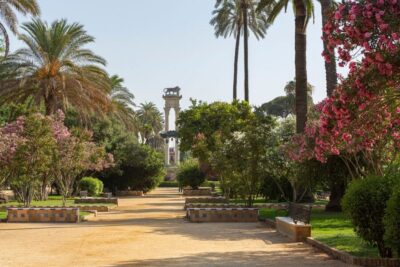
- Parque de María Luisa: the Moorish-style park that slows you down
- Plaza de España: Expo architecture you can really see
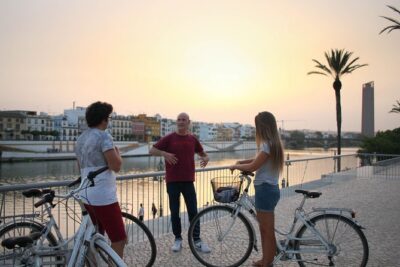
- Torre del Oro and the Triana Bridge: river history from the saddle
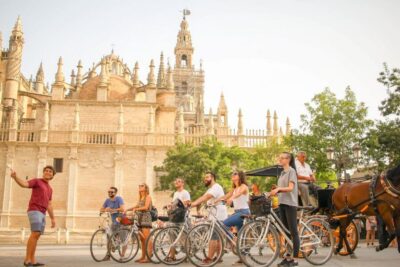
- Giralda, Seville Cathedral, and the Alcázar: the skyline bundle
- The Giralda as a minaret turned icon
- Seville Cathedral: big scale, specific names
- The Royal Alcázar: Mudéjar first, layers everywhere
- Guide quality and pacing: the difference between moving and learning
- What to bring, and how to avoid awkward bike moments
- Price and value: is $48.06 worth it?
- Should you book this electric bike tour in Seville?
- FAQ
- How long is the Electric Bike Tour in Seville?
- How much does it cost?
- What’s included in the tour price?
- Where does the tour start and where does it end?
- Is this tour private?
- What language is the tour offered in?
- What if the weather is bad?
- Can I cancel for a full refund?
Key things to know before you ride
- Parque de María Luisa first: Moorish-style landscaping, tiled fountains, palms and orange trees, and a whole lot of doves.
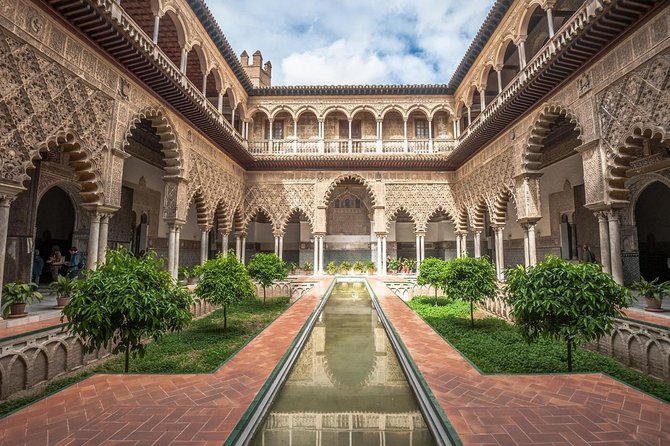
- Plaza de España on the route: you’ll see the Expo-era design blend of Baroque Revival, Renaissance Revival, and Neo-Mudéjar.
- Torre del Oro + Triana Bridge views: a river-focused segment that ties Seville’s past to today’s neighborhoods.
- Giralda and the Cathedral area: iconic skyline sights with context on the Almohad minaret and UNESCO status.
- Royal Alcázar nearby: Mudéjar architecture mixed with Gothic and Renaissance layers, plus a living royal presence in parts of the complex.
- Small-time commitment: about 2.5 to 3 hours, and you’re back at Plaza de Santa Cruz.
Seville by bike, a few more routes
- Seville Highlights Bike Tour (English)★ 5.0 · 2,225 reviews
- Seville: Highlights City Bike Tour★ 4.8 · 2,168 reviews
- Seville: Relaxing City Bike Tour with a Tour Guide★ 4.8 · 1,588 reviews
Why an electric bike tour fits Seville’s shape
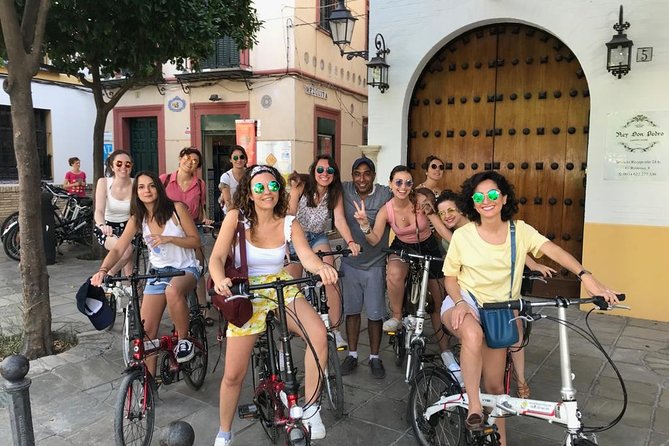
Seville is big, and the fun parts are spread out. This tour does a good job solving the main problem: you want to see the highlights, but you don’t want to spend the day doing stop-and-go walking.
An electric bike makes a difference in two ways. First, it helps you keep a steady pace through parks and between landmarks. Second, it makes the route feel beginner-friendly. Even if Seville is not a mountain city, there are longer stretches and small rises that can add up when you’re on foot. With the motor boost, you can focus on the views and the guide’s explanations rather than negotiating fatigue.
Also, the tour is offered in English, and it’s designed for all ages and skill levels. That usually means the guide’s job is to keep everyone together and relaxed—no one is left behind doing emergency cardio.
Meeting at Plaza de Santa Cruz and getting oriented fast
You start at Plaza de Santa Cruz (Pl. de Sta Cruz, Casco Antiguo, 41004 Sevilla). From there, you roll through central streets and park areas that make it easy to connect the dots between Seville Cathedral, the river zone, and the grand green spaces.
You also get a small but important comfort package: bottled water, a local guide, and the bike plus helmet. Since food and drinks are not included, it helps to treat this as a moving orientation tour. You’ll likely work up an appetite afterward, but you won’t arrive hungry during the ride.
One practical tip: the best e-bike tours explain the bike controls right away. There’s a common piece of advice that shows up—ask the guide to show you how the electric assist works before you start moving. If you’re new to e-bikes, that minute at the beginning can save you from fumbling later.
Parque de María Luisa: the Moorish-style park that slows you down
You begin at Parque de María Luisa, a park with a story that’s part gift, part design project, and part long-term public space. The grounds were once gardens connected to the Palace of San Telmo, donated to the city in 1893 by the Duchess of Montpensier. Later, an architect named Aníbal González helped develop the park’s role in the Ibero-American Exposition of 1929.
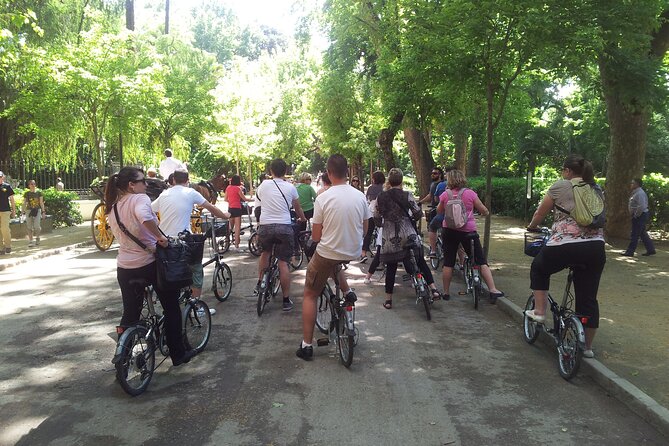
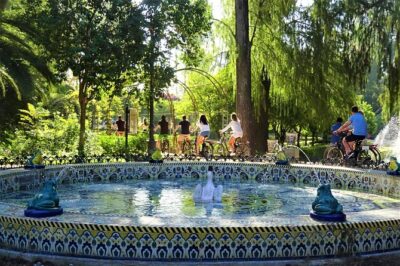
What you feel on a bike here is space. The park is laid out like an open-air set: tiled fountains, pavilions, walls, ponds, benches, and even exhedras—those semi-circular seating or wall structures. There are lush plantings like palms, orange trees, Mediterranean pines, and stylized flower beds tucked behind vines. It’s the kind of place where your brain switches from street mode to park mode.
It’s also described as a kind of botanical garden, with educational panels that point out native and exotic plant species. And yes, there’s a big local bird presence—doves are especially well known here.
Drawback to know: you still need to share space with park paths and scenery stops. This is not a high-speed biking ride. It’s more about gliding slowly enough to take it in.
Still deciding? A few more Seville picks worth a look.
Plaza de España: Expo architecture you can really see
From the park, you roll toward Plaza de España inside Parque de María Luisa. This plaza was built in 1928 for the Ibero-American Exposition of 1929, and it’s one of the easiest places in Seville to understand the city’s taste for monumental design.
Architecturally, the plaza is a blend. You’ll see elements of Baroque Revival, Renaissance Revival, and Moorish Revival (Neo-Mudéjar) styles. It’s not random. The whole place feels like a planned, theatrical statement: long views, tiled surfaces, and dramatic geometry that makes photos look good without effort.
Time note: the stop here is short, so think of it as a highlight scan. You’ll appreciate the scale most if you keep your eyes moving—arches, tilework, and the way the plaza opens outward.
If you’re the type who wants to read every plaque and soak in interiors, you might want to come back later on your own. But for a 2.5 to 3 hour tour, this stop hits the biggest hits fast.
Torre del Oro and the Triana Bridge: river history from the saddle
Next comes the river zone. Torre del Oro is one of those sights that instantly gives Seville a military-and-trade edge. This dodecagonal watchtower was erected by the Almohad Caliphate to control access to Seville via the Guadalquivir river.
Constructed in the first third of the 13th century, it later served as a prison during the Middle Ages. The name Torre del Oro, or Tower of Gold, connects to the tower’s golden shine on the river—linked to the building materials: mortar, lime, and pressed hay.
One detail that’s fun to keep in mind as you look at it: the tower is divided into different levels built at different times. The first dodecagonal level was built in 1220 by order of the Almohad governor Abù l-Ulà. A second dodecagonal level appears in the 14th century, associated with Peter of Castile and supported by archaeological studies. After the 1755 Lisbon earthquake damaged the upper part, the top was rebuilt in 1760 by Sebastian Van der Borcht.
After that, you cross into the area near Puente de Isabel II, also called Puente de Triana. This metal arch bridge connects Triana to the city center and crosses the Canal de Alfonso XIII, which helps isolate Triana as an almost-island.
Here’s the historical kicker: the bridge was completed in 1852 as the first solid bridge in Seville, replacing an earlier pontoon bridge made of boats. And there’s even earlier history: pontoon bridges had Moors’ beginnings in the 12th century, lasting for seven centuries thanks to repairs.
What you get from biking through this area is perspective. You see the city as a system—river access, neighborhood identity, and landmark placement all tied together.
Giralda, Seville Cathedral, and the Alcázar: the skyline bundle
After the river, the tour heads toward the symbols people actually come to see: the Giralda, Seville Cathedral, and the Royal Alcázar.
The Giralda as a minaret turned icon
The Giralda is the bell tower of Seville Cathedral. It began life as the minaret for the Great Mosque of Seville during the Almohad dynasty in al-Andalus. Later, the Catholic rulers added the Renaissance-style top after the reconquest era. It’s listed by UNESCO (1987) as part of a World Heritage grouping with the Alcázar and the General Archive of the Indies.
The tower’s height is 104.1 meters and it’s been a Seville symbol since the Middle Ages. Even if you don’t go inside on this tour, you’ll get the visual payoff.
Seville Cathedral: big scale, specific names
Seville Cathedral is a Roman Catholic cathedral and is described as the fourth-largest church in the world and the largest Gothic church. The building covers 11,520 square meters.
A guide can make this place feel more human by sharing who is tied to it. You’ll hear about events like the baptism of Infant Juan of Aragon in 1478. You’ll also hear about the royal chapel holding remains of key figures such as Ferdinand III of Castile, Alfonso the Wise, and Peter the Just.
There are also burial links connected to Christopher Columbus and his son Diego, plus funerary monuments for cardinals Juan de Cervantes and Pedro González de Mendoza.
The drawback here is simple: cathedral stops from a bike route are time-limited. You’ll see the important features and get the context, but you won’t get the same depth as a dedicated cathedral visit.
The Royal Alcázar: Mudéjar first, layers everywhere
Finally, you reach the Royal Alcázar of Seville (Reales Alcázares de Sevilla). This is historically tied to al-Qasr al-Muriq, the Verdant Palace. The Christian king Peter of Castile built his royal palace on the site of an earlier Abbadid Muslim fortress that was destroyed after the Christian conquest.
Architecturally, it’s known for Mudéjar style, with Gothic, Renaissance, and Romanesque design elements added over time. Some parts still function as a residence: the upper storeys are occupied by the royal family when they are in Seville, and administration is handled by Patrimonio Nacional.
It’s also part of the same UNESCO 1987 set as the cathedral and the archive.
What you’ll like, if you’re the type who likes seeing style evolution, is how the Alcázar is a meeting point of influences. Even without going deep into rooms, the location in the route helps you understand why the city is seen as a crossroads between cultures.
Guide quality and pacing: the difference between moving and learning
A big reason this tour works is the guide. The ride is short enough that the guide has to be efficient, and that means you get a steady stream of context without long speeches.
Names linked to great experiences include Veronica, Juan, Danny/Daniel, Elena, Tristan, Matis, Ben, Alejandro, and Medhi. The common thread is how they explain history in a way that connects to what you’re literally looking at from the bike.
The pacing also helps. A couple people noted the ride felt quick and covered a lot territory in about three hours, which is exactly what you want on a first visit. You get the main park, one major plaza, river sights, and the skyline cluster—without spending the day repeating directions.
One more safety point: e-bike tours succeed when the guide gives clear instructions and keeps everyone calm. If you’re nervous, ask for help figuring out the electric assist before you start.
What to bring, and how to avoid awkward bike moments
This tour runs in all weather conditions, so dress for that. Rain can turn park paths slick, and heat can drain you even with electric assist. Plan for comfort over fashion.
Also, pack for a two-and-a-half-to-three-hour ride:
- Helmet is provided, but it’s still smart to wear something comfortable under it.
- Bottled water is included, but you’ll want to consider what you’ll do after the tour since food and drinks are not included.
- If you’re riding with kids or shorter riders, confirm bike sizing ahead of time. One experience described a child too small for an e-bike getting a standard bike instead, which is fine if the rider can handle it.
If you’re not a confident rider, choose calm energy. You don’t need to sprint. The goal is to cruise, take in the sights, and absorb what the guide points out.
Price and value: is $48.06 worth it?
At $48.06 per person for roughly 2 hours 30 minutes to 3 hours, this sits in the middle of what you’d pay for a guided tour that includes actual transportation. The value improves when you look at what’s included: bottled water, a local guide, and use of the bicycle and helmet.
You’re also paying for time savings. Seville landmarks like Plaza de España, Torre del Oro, the Giralda area, and the Alcázar are spread out enough that a car or a guided route can reduce wasted transit time. On a bike tour like this, you’re stacking sightseeing efficiently.
The other value boost is the reduced friction. The electric assist makes the tour doable across skill levels, so you’re more likely to enjoy it end-to-end instead of spending half your energy just trying to keep up.
The only value risk is expectations. If you want deep interior visits of major sites, this tour is more of an orientation and skyline overview from a bike-friendly route. It’s still a strong way to decide what you want to spend more time on afterward.
Should you book this electric bike tour in Seville?
Book it if:
- You want the best highlights in a short time without a day of walking.
- You like getting stories tied to real landmarks—parks, plazas, the river, and the cathedral skyline.
- Your group has mixed ages or different biking comfort levels.
- You’re okay with a ride that prioritizes seeing and learning over long museum-style stops.
Skip it (or add a different day) if:
- You need long, quiet time inside the Cathedral or deep into Alcázar rooms. This tour is focused on getting you oriented and giving context, not replacing ticketed visits.
- Your group includes very small children who might not fit the e-bike sizing well. You can still go, but you want to make sure bike sizing works.
If your goal is a fast, friendly, practical way to understand Seville—parks plus icons plus river views—this one is a strong match. You’ll come away with a mental map and a sense of why these landmarks connect, and that makes the rest of your time in Seville feel easier.
FAQ
How long is the Electric Bike Tour in Seville?
It runs about 2 hours 30 minutes to 3 hours.
How much does it cost?
The price is $48.06 per person.
What’s included in the tour price?
You get bottled water, a local guide, and use of the bicycle and helmet.
Where does the tour start and where does it end?
It starts at Plaza de Santa Cruz and ends back at the same meeting point.
Is this tour private?
Yes. Only your group participates.
What language is the tour offered in?
The tour is offered in English (and it may be operated by a multi-lingual guide).
What if the weather is bad?
It operates in all weather conditions, so dress appropriately for rain or sun.
Can I cancel for a full refund?
Free cancellation is available. To get a full refund, cancel at least 24 hours in advance of the experience start time.
More Tours in Seville
- Seville: Alcázar, Cathedral & Giralda Skip-the-Line Tour
★ 4.8 · 11,525 reviews - Seville: Cathedral, Giralda & Alcazar Entry With Guided Tour
★ 4.6 · 8,560 reviews - Seville: Priority Access Cathedral, Giralda & Alcázar Tour
★ 4.8 · 7,563 reviews - Seville: Alcázar and Cathedral Entry Ticket and Guided Tour
★ 4.6 · 5,056 reviews - Seville: City Sightseeing Hop-On Hop-Off Bus Tour
★ 4.0 · 4,633 reviews
More Tour Reviews in Seville
- Seville: Live Flamenco Dancing Show Ticket at the Theater
★ 4.7 · 16,396 reviews - Seville: Alcázar, Cathedral & Giralda Skip-the-Line Tour
★ 4.8 · 11,525 reviews - Seville: 1-Hour Guadalquivir River Sightseeing Eco Cruise
★ 4.2 · 10,281 reviews - Seville: Setas de Sevilla Entry Ticket
★ 4.6 · 8,901 reviews - Seville: Cathedral, Giralda & Alcazar Entry With Guided Tour
★ 4.6 · 8,560 reviews
Pedalling Round Seville
- Seville Highlights Bike Tour (English)
★ 5.0 · 2,225 reviews - Seville: Highlights City Bike Tour
★ 4.8 · 2,168 reviews - Seville: Relaxing City Bike Tour with a Tour Guide
★ 4.8 · 1,588 reviews - Seville: City Sightseeing and Local Culture Bike Tour
★ 4.9 · 1,120 reviews - Seville Electric Bike Tour – Small Group
★ 5.0 · 841 reviews
Just added to the Seville list


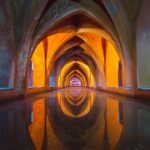
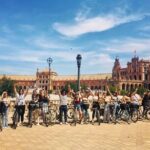
Seville Bike Tours, compared.
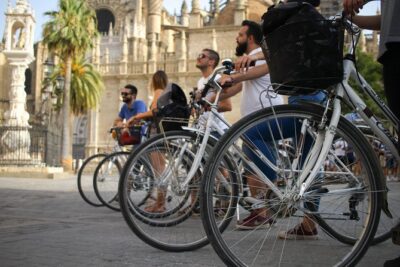 ★ 5.0Seville Highlights Bike Tour (English)From $422,225 reviews
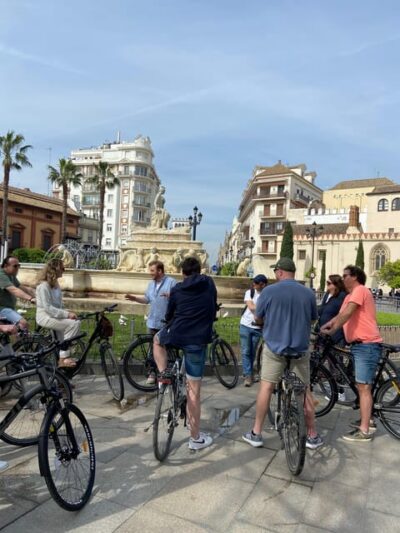 ★ 4.8Highlights City Bike TourFrom $382,168 reviews
 ★ 4.8Relaxing City Bike Tour with a Tour GuideFrom $351,588 reviews
 ★ 4.9City Sightseeing and Local Culture Bike TourFrom $311,120 reviews
 ★ 5.0Seville Electric Bike Tour – Small GroupFrom $58841 reviews
 ★ 5.0Sunset Guided Bike Tour in SevilleFrom $36438 reviews
 ★ 4.9Guided Sunset Bike TourFrom $41332 reviews
 ★ 5.03-hour Guided Bike Tour along the Highlights of SevilleFrom $39315 reviews
Browse the lists this tour appears in